The Australian Medical Council published its 2024-25 annual report in June 2026. It contains no pass rates. The statistics appendices that carried them in previous years are gone, and in their place is a page of volume counts.
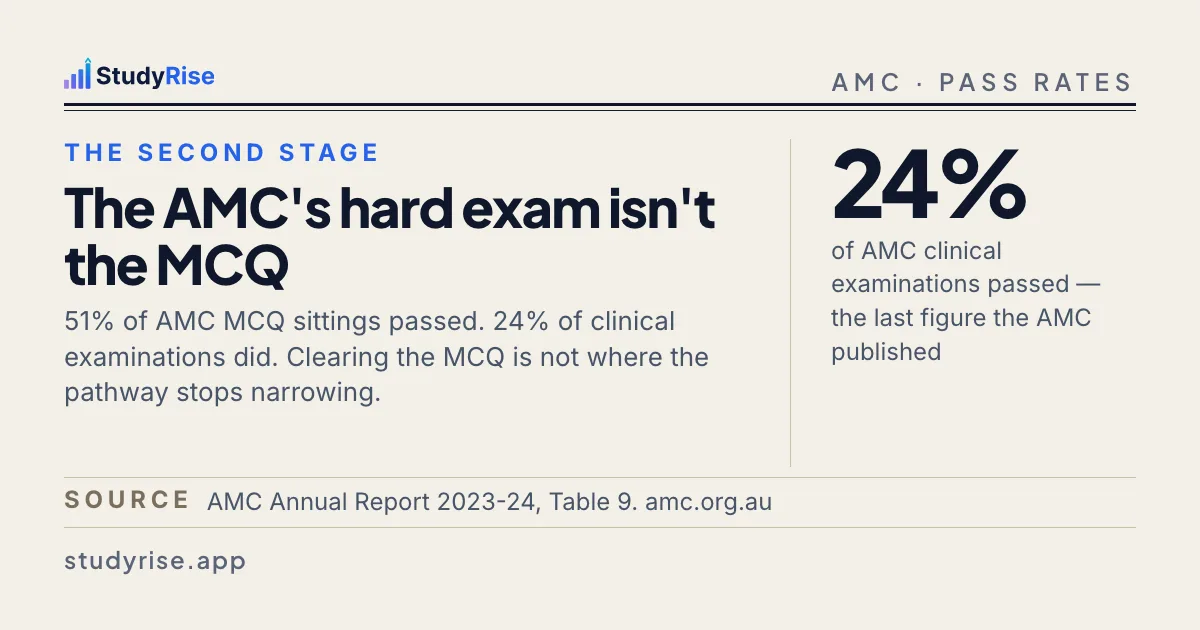
So the most recent AMC pass rates in existence are still the ones in the 2023-24 report: 51% for the MCQ and 24% for the clinical examination. Every page quoting an AMC pass rate today is quoting a two-year-old document, whether it tells you so or not. This one tells you so, and it uses the new report for everything the new report still covers.
What the AMC still publishes, and what it stopped
Two documents matter here: the AMC 2024-25 annual report, which is current, and the 2023-24 report, which is the last one to publish a pass rate. Both were checked on 13 August 2026.
| Assessment | Volume 2024-25 | Last published pass rate |
|---|---|---|
| CAT MCQ examination | 7,821 examinations, up 23% | 51% in 2023-24 (3,234 of 6,331) |
| Clinical examination | 2,401 examinations, up 8% | 24% in 2023-24 (509 of 2,107) |
| Workplace based assessment | 400 assessments, up 40% | 285 passed, 1 failed, in 2023-24 |
Read the two columns together and one thing jumps out. The MCQ grew 23% in a year. The clinical examination grew 8%. Be careful what you take from that gap: these are counts of examinations the AMC conducted, and the report publishes no capacity figure, no waiting time and no backlog anywhere in it. Slower growth at stage two is just as consistent with fewer people reaching it. What the table does establish is the pass rate column, and that is the part worth planning around.
The MCQ passes about half, and the cohort keeps growing
The AMC conducted 7,821 MCQ examinations in 2024-25, up 23% on the previous year's 6,331, which was itself up 42% on the year before that. The new report splits them: 2,482 sat in Australia and 5,339 sat internationally.
The last published pass rate for that examination is 51%, from 2023-24, when 3,234 of 6,331 examinations were passed. The year before it was 47%.
The country mix has shifted, and the shift is recent. In 2024-25 the largest group by country of training was India with 936, ahead of Sri Lanka with 819, the Philippines with 590, Pakistan with 587, China with 468 and Bangladesh with 432. A year earlier Sri Lanka led comfortably with 1,219 against India's 732. India overtaking Sri Lanka inside one reporting year is the single biggest change in the composition of this cohort.
One caveat about the 51% that the 2023-24 report's own wording makes clear: it is a percentage of examinations, not of people. A candidate who sits twice counts twice in the denominator, and once in the numerator if the second attempt goes well. The proportion of individual doctors who eventually pass is therefore higher than 51%, and the proportion who pass first time is lower. Neither number is published. Any page quoting one is estimating.
Even read generously it is not a formality. Roughly half of all MCQ sittings did not end in a pass, on an examination of 150 questions in a single 3.5-hour adaptive session where you cannot return to a question once you have answered it.
The number nobody quotes
Here is the figure that changes how the pathway looks. In 2023-24 the AMC conducted 126 clinical examination sessions, assessing 2,107 international medical graduates. 989 presented for the first time. 509 passed and qualified for the AMC Certificate. The report gives the percentage passed as 24%.
Set that beside the MCQ and the shape of the Standard Pathway inverts. The examination that gets nearly all of the attention, the question banks and the study plans passes about half its sittings. The one after it passes about a quarter.
Two honest qualifications before anyone builds a strategy on that comparison. First, the populations differ: everyone eligible can sit the MCQ, but only candidates who have already passed it reach the clinical examination, so that cohort has been filtered once already. A lower pass rate among an already-filtered group argues for the assessment being harder rather than easier, but the two percentages are not measuring the same thing.
Second, the standard moved. The AMC records that in March 2024 its Directors agreed to change the pass mark of the clinical examination after a review that included international benchmarking. Candidates previously had to pass ten of fourteen stations; they now need nine of fourteen. The rise from 21% to 24% sits across that change, so it should not be read as candidates having got better.
The AMC has not ignored the bottleneck. Its 2024-25 report records a new purpose-built test centre in Melbourne, opened in February 2025, and a fee cut on the clinical examination from $3,991 to $3,000 in person and from $4,391 to $3,400 online, effective 1 July 2025, with refunds processed for candidates already booked. The MCQ fee fell from $3,124 to $2,920. Those are real improvements to cost and capacity. They do not change the pass rate.
What the comparison supports is a narrow and useful claim: passing the MCQ is not the moment the hard part is behind you. A good deal of preparation advice, including advice that is otherwise sound, is written as though it were.
The other second stage, and why its numbers are not a shortcut
The clinical examination is not the only route to an AMC Certificate. Workplace based assessment is an alternative second stage: pass the CAT MCQ examination, then complete a 6 to 12 month programme of supervised assessment with an AMC-accredited provider instead of sitting the clinical exam. Our guide to the two routes into Australian practice covers where both sit in the wider pathway.
WBA is growing faster than either examination. The AMC records 400 workplace based assessments in 2024-25, up 40%, across a provider list that has expanded to 31 accredited health services with five given initial accreditation that year. In 2023-24 the equivalent figure was 285 passes against one failure.
It would be easy, and wrong, to put 285-and-1 beside 24% and conclude WBA is the soft option. The 2023-24 report's own application figures are what stop you: 399 candidates applied to providers for a WBA place that year and 9 applications were rejected by the AMC, with 315 assessments in progress. Those applications are made to individual health services, and a candidate must hold a post at one before any assessment begins.
That is where the selection happens, and it happens before the pass figures start counting. A pass rate calculated on people already recruited into a supervised year of practice is not comparable to one calculated on everyone who booked an exam. The 285 and the 1 are a real and encouraging fact about what happens once you are inside a WBA programme. They say much less about your chances of getting into one.
The practical read: if a WBA post is open to you, the evidence that people complete it successfully is strong. Treating it as a way around a 24% pass rate misreads which part is the bottleneck.
What a "90% success rate" measures
Now the advertised figures make more sense. When a coaching provider reports that over 90% of its candidates passed, it is usually describing students who enrolled, completed the course and went on to sit the examination. That denominator excludes everyone who enrolled and did not finish, and everyone who finished and did not sit.
The AMC's 51% counts every examination sat by anyone, prepared or not, first attempt or fourth.
These are not competing claims about the same quantity, and the provider's number is not necessarily false. It is a different measurement, published by the party with an interest in it, and it cannot be set against a regulator's figure without saying what changed in the denominator. Ask a provider what the denominator was, not whether the number is true.
What this changes about preparing
If about half of MCQ sittings pass and about a quarter of clinical sittings do, a plan that treats the MCQ as the finish line is planning for the easier half of the problem.
Plan the runway for both stages from the start. The knowledge the clinical examination tests is largely the same knowledge applied under different conditions, and the candidates who struggle most at the second stage are often the ones who cleared the first on a hard sprint and let the material fade. Treat the second stage as its own scheduling problem rather than a continuation of the first: the clinical examination runs in a limited number of scheduled sessions — 126 of them in 2023-24 — and you cannot sit one until the MCQ is behind you. The AMC does not publish waiting times, so any specific gap you see quoted is somebody's estimate rather than a published figure.
So keep month one alive into month eleven. Space your revision rather than massing it, and treat retention as the objective rather than a side effect. Set the runway with a realistic AMC MCQ study plan, keep it survivable with a sustainable daily question load, and let spaced repetition decide whether month one is still there when the second stage arrives. If the acronyms still blur, what AMC stands for separates the AMC from Ahpra and the Medical Board, and the 2026 pass-standard change covers the one moving part on the MCQ itself.
StudyRise's AMC study planner is built on that principle and reschedules around the weeks that go wrong. It is not required to pass, and it would be silly to pretend otherwise when doctors passed this examination for years with a paper diary. What it removes is the need to hold an eleven-month timetable in your head, which is worth more in month eight than it sounds in week two.