AMC CAT MCQ · For International Medical Graduates

Plan your AMC MCQ prep, one clear week at a time

StudyRise turns your AMC exam date into a week-by-week study plan across the whole AMC blueprint — then tracks what you have covered and how ready you are. Built for IMGs sitting the Australian Medical Council exam.

150
A-type MCQs in one sitting
3.5 hrs
One adaptive session
250 / 500
Pass mark on the ability scale
30 days
Full access free, no card
Try it — no signup

Build a sample AMC plan outline

Pick your AMC subjects and your study pace, and see the phased plan StudyRise would build — total study hours, tasks per phase, and whether it fits before your exam. It's an outline; inside the app it becomes a real, dated, self-adjusting plan.

Your AMC subjects

All 22 AMC blueprint subjects are included by default — untick any you're not covering.

Your pace

How many hours a day you can study, and (optionally) your exam date for a fit check.

Know what you're planning for

The AMC MCQ, in plain terms

You can't build a study plan for an exam you only half understand. Here's the shape of it.

The AMC CAT MCQ is the first exam in the Standard Pathway for IMGs seeking registration in Australia — often called AMC Part 1. It is a computer-adaptive test of 150 A-type multiple-choice questions, each with one best answer out of five, sat in a single 3.5-hour session at a Pearson VUE centre.

Because it adapts, every candidate gets a slightly different paper: answer correctly and the next question gets harder; answer wrong and it gets easier. So your score reflects the difficulty you handled, not just the count of right answers.

There is no negative marking, and you are expected to answer all 150 items. Results sit on an ability scale from 0 to 500, with a pass at 250 — benchmarked to the standard of a graduating Australian medical student.

The questions are clinical and reasoning-led, framed in Australian practice. They span six patient groups across the blueprint:

Adult health — medicine Adult health — surgery Women's health (O&G) Child health Mental health Population health & ethics

Adult internal medicine carries the largest share, with surgery next and the remaining groups taking smaller, roughly even slices. For the exact weighting and the official rules, read the AMC MCQ examination page and its Examination Specifications booklet.

The real problem

Most AMC prep doesn't fail on knowledge. It fails on planning.

The AMC syllabus is wide, your exam date is months away, and the resources pile up fast — Murtagh's General Practice, the AMC Handbook of MCQs, a question bank or two, plus whatever you can fit around work or a clinical job. It is easy to study hard for weeks and still not know whether you are on track.

The usual failure points are familiar:

  • You start strong on medicine, run out of runway, and barely touch psychiatry or population health before the exam.
  • You finish a topic in month one and have forgotten most of it by month three, because nothing brought it back.
  • You fall a week behind, never rebuild the plan, and spend the final month anxious instead of revising.
  • You grind question banks without knowing which weak areas actually need the hours.

None of this is a knowledge problem. It is a scheduling and tracking problem — and that is the part a good plan fixes.

A plan that fits the AMC

Four habits that keep AMC prep on track

Use these whether you plan on paper or in an app. StudyRise just makes them automatic.

Work backwards from the date

Start from your booked sitting and fill time backwards, so the whole blueprint is covered with weeks to spare for revision — not crammed into the end.

Cover every patient group

Spread your weeks across all six AMC areas from the start. The exam tests breadth; a plan that protects the smaller groups beats one that over-invests in medicine.

Build in spaced review

Schedule each topic to come back before it fades. Revisiting medicine in week 8, not just week 1, is what makes it stick to exam day.

Let weak areas pull your hours

Track how you score by topic and move time toward what's shaky. With no negative marking, the goal is steady accuracy across the board, not perfection in one area.

How StudyRise helps

Set your exam date. Get a plan you can actually follow.

StudyRise is a study-planning app, not another question bank — it organises the prep you already do around your AMC date.
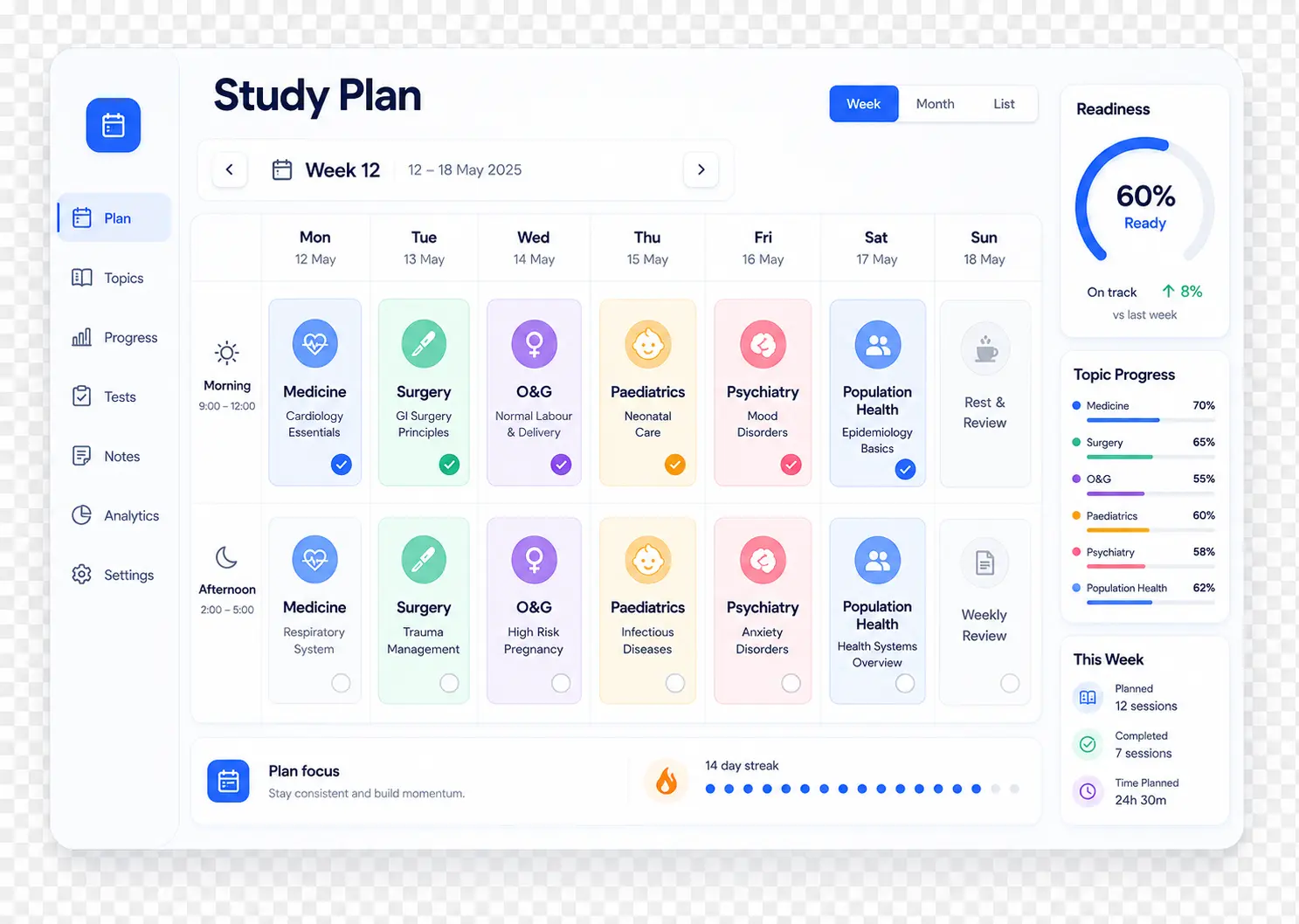
StudyRise AMC MCQ study planner showing a week-by-week plan across the six AMC patient groups with progress tracking
A StudyRise AMC plan — the blueprint mapped across your weeks, with review built in.

Tell it your date and hours

Enter your AMC MCQ sitting and how many hours you can study each week. That's the whole setup.

Get a week-by-week plan

StudyRise lays out the full AMC blueprint across your weeks, with spaced review built in so nothing you cover early slips away.

Track and adapt

Tick off what you finish, log how topics feel, and let the plan rebalance when life moves a week. Exam Mode projects how ready you are as the date nears.

Start planning your AMC prep today

30 days of full access, free. No card required — set your date and see your first plan in minutes.

Try StudyRise free
Simple, honest pricing

Free to start. Free to keep using.

Every new account gets 30 days of full access, free, with no card required. After that, the basics stay free for as long as you need them, and advanced planning features are part of Pro. See exactly what's included on the pricing page.

See what's included

AMC MCQ planning — quick answers

How long should I prepare for the AMC MCQ?
Most IMGs give themselves three to six months of consistent study, depending on how long they've been away from clinical exams and how many hours they can study each week. What matters more than the total is structure: a plan that works backwards from your booked date and protects time for review. StudyRise builds that plan from your exam date and weekly availability.
Is there negative marking in the AMC CAT MCQ?
No. There's no negative marking, so a wrong answer is never worse than a blank one. You're expected to answer all 150 questions, and leaving the hard ones blank only costs you the chance to score on them.
How is the AMC MCQ scored?
It's a computer-adaptive test reported on an ability scale from 0 to 500, with a pass at 250. Because it adapts, a correct answer leads to a harder question and a wrong one to an easier question — so two people with the same number correct can finish on different scores. The pass standard is set at the level of a graduating Australian medical student.
Can StudyRise build a plan specifically for the AMC MCQ?
Yes. StudyRise has an Exam Mode for international licensing exams including the AMC MCQ. You set your date and weekly hours, and it lays out a week-by-week plan across the AMC content areas, schedules review so earlier topics don't fade, and projects how ready you are as your sitting nears.
Do I need a credit card to start?
No. Every new account gets 30 days of full access free, no card required. After that, basic features stay free and advanced features need a Pro subscription. The full breakdown is on the pricing page.
Is this the same StudyRise as the Indian company with a similar name?
No. StudyRise at studyrise.app is a study-planning and tracking app for international medical graduates, MBBS students and university students. It's unrelated to any similarly named company. Its tagline is "Plan today. Rise tomorrow."

Turn your AMC date into a plan

Set your sitting, add your weekly hours, and watch StudyRise map the whole blueprint across your weeks. Free for 30 days — no card required.