The results for this question split down the middle without telling you they have. Half are university pages written for a seventeen-year-old choosing subjects. The other half are agency pages written for a thirty-four-year-old cardiologist in Lahore. Both are answering the question honestly. Only one of them is answering yours.
So the useful first move is to sort yourself into the right half, because the two routes share a regulator and almost nothing else.
Two questions hiding inside one search
Both routes end at the same body: nobody practises medicine in Australia without registration from the Medical Board of Australia. Which kind of registration differs, and that is worth knowing early. Australian graduates and international graduates on the Standard and Competent Authority pathways are working towards general registration.
Overseas-trained specialists on the Specialist and Expedited Specialist pathways are working towards specialist registration instead, and the Short-Term Training Pathway leads to a time-limited registration for a defined training period rather than a permanent one. Everything before those endpoints differs too.
If you have not studied medicine yet, your work is admission: getting into an accredited Australian medical programme and finishing it. If you already have a medical degree from another country, your degree is not in question; what you need is a way to have it assessed against Australian standards. Those are different problems, and reading the wrong guide for a fortnight is a common and entirely avoidable way to lose time.
Route one: through an Australian medical school
Medical programmes in Australia are accredited by the Australian Medical Council, which sets the standards a course has to meet and then assesses courses against them. The AMC publishes the list of accredited providers, and reading it is more informative than most course-comparison articles, because it shows you the shape of the sector rather than one school's pitch.
The AMC's accredited-programs list carried 23 Australian entries across 22 universities when we checked it on 13 August 2026, alongside two in New Zealand whose graduates the accreditation also covers. Accreditation lists change, so check it rather than quoting this page back at anyone. What the list makes obvious is that the qualification is no longer one thing.
Most programmes now award a Doctor of Medicine, some as a standalone graduate-entry degree and many as a combined bachelor-plus-MD. Only two providers on the current list, Curtin University and James Cook University, still run a straight Bachelor of Medicine / Bachelor of Surgery, and three more carry an MBBS marked "teach out" while the last cohorts finish.
That matters practically. A combined bachelor-plus-MD and a standalone graduate-entry MD are different lengths and take different entry routes, so "how many years is medicine in Australia" has no single answer and any page that gives you one is rounding off something important. Check the programme, not the country.
After graduating you work under supervision as an intern in an accredited training programme before you can hold general registration. The Medical Board of Australia sets those requirements, and it is the place to confirm them rather than any guide, this one included.
Route two: the IMG pathway, with a medical degree from overseas
This is where most people arrive at this question, and it is where the guidance in circulation is weakest. The common assumption is that an international medical graduate books the AMC exam and starts studying. Plenty of doctors do exactly that before establishing whether the exam applies to them.
The AMC and the Medical Board run several distinct pathways. They are parallel routes with different assessors, so sorting yourself into the right one comes before everything else.
Start here. Find the row that describes you, then read the detail below it.
| If this is you | Your route | AMC exam? |
|---|---|---|
| Overseas graduate, general registration, not eligible for Competent Authority | Standard Pathway | Yes — MCQ, then clinical exam or WBA |
| Trained or assessed by an authority the Medical Board recognises | Competent Authority Pathway | No — that authority's assessment replaces it |
| Overseas-trained specialist seeking specialist registration | Specialist Pathway | No — the Australian specialist college assesses you |
| Specialist whose qualification the Board has assessed as substantially equivalent | Expedited Specialist Pathway | No |
| Coming temporarily for training, typically up to 24 months | Short-Term Training Pathway | No — leads to time-limited, not general, registration |
- Standard Pathway. The AMC describes it as being for international medical graduates seeking general registration who hold an eligible primary medical qualification and who are not eligible for the Competent Authority Pathway. This is the route with the AMC examinations on it.
- Competent Authority Pathway. For graduates whose training or assessment comes from an authority the Medical Board recognises. The AMC advises the Board on which authorities are recognised, and the Board decides; the AMC says it is not responsible for the eligibility and assessment processes on this pathway. It leads to general registration and carries no AMC examination — the recognised authority's own assessment stands in their place. The recognised list changes, so read the Board's current one rather than a forum post.
- Specialist Pathway. For overseas-trained specialists seeking specialist registration. Assessment is done by the relevant Australian specialist medical college, and the AMC states plainly that it does not conduct assessments for this pathway.
- Expedited Specialist Pathway. For specialists holding a qualification the Medical Board has assessed as substantially equivalent to an approved Australian specialist qualification. Also aimed at specialist registration, and again no AMC assessment.
- Short-Term Training Pathway. For overseas specialists or specialists-in-training coming for temporary training, typically up to 24 months, with no AMC assessment role. It leads to a time-limited registration for that training, not to general registration.
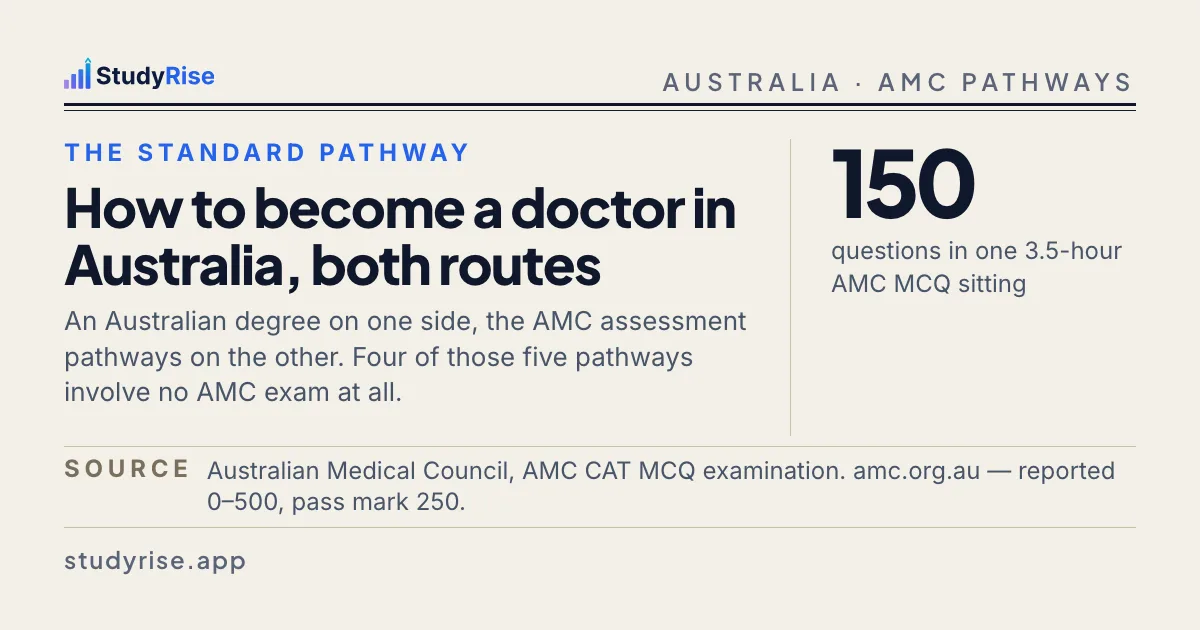
Four of those five involve no AMC examination whatsoever. Only the Standard Pathway puts an AMC examination in front of you: on the Competent Authority Pathway a recognised authority's assessment does that work instead, and on the three specialist and training pathways the AMC does not assess candidates at all.
That is the single most useful fact on this page for an overseas-trained doctor, and it is buried three clicks deep on a regulator's website while exam-prep advertising sits at the top of every search result.
Your pathway is decided before you sit anything
Notice how the Standard Pathway is defined: it is the route for people who are not eligible for the Competent Authority Pathway. Eligibility is worked out from your qualification and where you trained, and it is settled before you ever open a question bank. A candidate who assumes the Standard Pathway and starts revising may be preparing for an examination their pathway never asked for.
So the honest sequence for an international graduate is: establish your pathway first, then plan study around whatever that pathway requires. It is a boring step that saves months, which describes most of the advice worth having in this area.
One more thing worth knowing before you spend money. The AMC lists bridging courses on its website but states that it does not endorse or accredit individual bridging programmes, and that checking a course's claims is the candidate's responsibility. A listing is an information service, not a recommendation, and that distinction is easy to miss when a course quotes the listing in its marketing.
What the AMC examinations actually involve
If you are on the Standard Pathway, two assessments stand between you and an AMC certificate.
The first is the AMC CAT MCQ examination. It is computer-administered and delivered in one 3.5 hour session at examination centres worldwide, run by Pearson VUE on the AMC's behalf. It consists of 150 multiple choice questions, each with one correct response from five options, and you are expected to complete all 150 scored items. Performance is reported on a scale of 0 to 500 with the pass mark described as 250.
From 2026 the AMC is introducing a slight increase to that pass standard, integrated into the same scale, which our guide to the 2026 pass-standard change covers in detail. The AMC also offers a free preparation app built with eMedici, containing 210 practice questions, which is worth using before paying for anything.
The second stage is either the AMC clinical examination or a workplace based assessment programme, which the AMC describes as running over a 6 to 12 month period. Plenty of candidates assume WBA comes after the clinical examination. It replaces it, and that misunderstanding is common enough to be worth saying plainly.
The clinical examination comprises 16 assessed stations and four rest stations. Each station runs 10 minutes: two minutes reading time, then eight minutes of assessment. Stations cover medical, surgical, women's health, paediatrics and mental health presentations across community and hospital settings, and each focuses on history taking, examination, diagnostic formulation, or management and counselling.
Two of the 16 are pilot stations, so your result is determined by 14 scored stations, and a pass means a pass score in 9 or more of those 14. You must have passed the MCQ examination before you are eligible for it.
Those numbers reward a particular kind of preparation. Fourteen scored stations is a small sample of a very large syllabus, and 150 questions across the whole of clinical medicine is thin coverage of enormous ground. Neither exam is beaten by knowing a few topics thoroughly. Both are beaten by covering the breadth and, crucially, still remembering the early material on the day, which is a scheduling problem at least as much as a knowledge one.
Assessment is not registration
This trips up more people than any exam question. The AMC sets standards and assesses. The Medical Board of Australia is the regulator that grants registration, and Ahpra administers registration on the Board's behalf. Clearing your AMC assessment gets you an AMC certificate, which feeds into a registration application that is a separate process with its own requirements, typically including English language evidence and a period of supervised practice.
If the three bodies still blur together, our explainer on what AMC stands for separates them properly, and the medical licensing exams overview puts the Australian route beside the other main options if you are still comparing countries.
What this means for how you prepare
Suppose you have confirmed the Standard Pathway applies to you. The work ahead is wide and long, and what usually breaks it is drift: covering cardiology properly in month one, finding it gone by month five, then rebuilding it in a panic while the rest of the syllabus waits.
That is why a preparation plan with deliberate revisiting built into it outperforms a bigger question bank for most candidates. A realistic AMC MCQ study plan sets the runway, a sustainable daily question load keeps it survivable on ordinary weeks, and spaced repetition is what stops month one leaking away by month five. StudyRise's AMC study planner builds a schedule on that principle and reschedules around the weeks that go wrong, which every long preparation eventually has.
None of that is required to pass. Doctors have passed the AMC with a paper diary and considerable stubbornness. What a plan buys you is the ability to stop holding the whole timetable in your head, which is worth more in month four than it sounds in week one.