You reviewed fifty pages last week. How many could you write out from memory right now? For most people the honest answer is "not many." That gap between effort and retention is the whole problem spaced repetition solves.
The good news is that the fix isn't more hours. It's better timing. This guide explains what spaced repetition is, why it works, and (the part most articles skip) exactly how to schedule your reviews around a real exam date, by hand or with a tool.
What is spaced repetition?
Spaced repetition is a study technique where you review material at increasing intervals instead of all at once. You learn something today, revisit it tomorrow, then in a few days, then a week later, then a couple of weeks after that, each gap a little longer than the last.
The opposite is what most of us default to: massed practice, better known as cramming. Cramming packs every encounter with a topic into one block. It feels efficient and produces a confident glow on the day. Then most of it drains away within a week.
Here's the technique in one example. You read a history chapter on Monday. Instead of rereading it five times that night, you close the book and test yourself on it Tuesday, again on Thursday, again the following Monday, and once more two weeks later. Same chapter, far fewer total minutes, and a memory that's still there on exam day.
Why it works: the forgetting curve
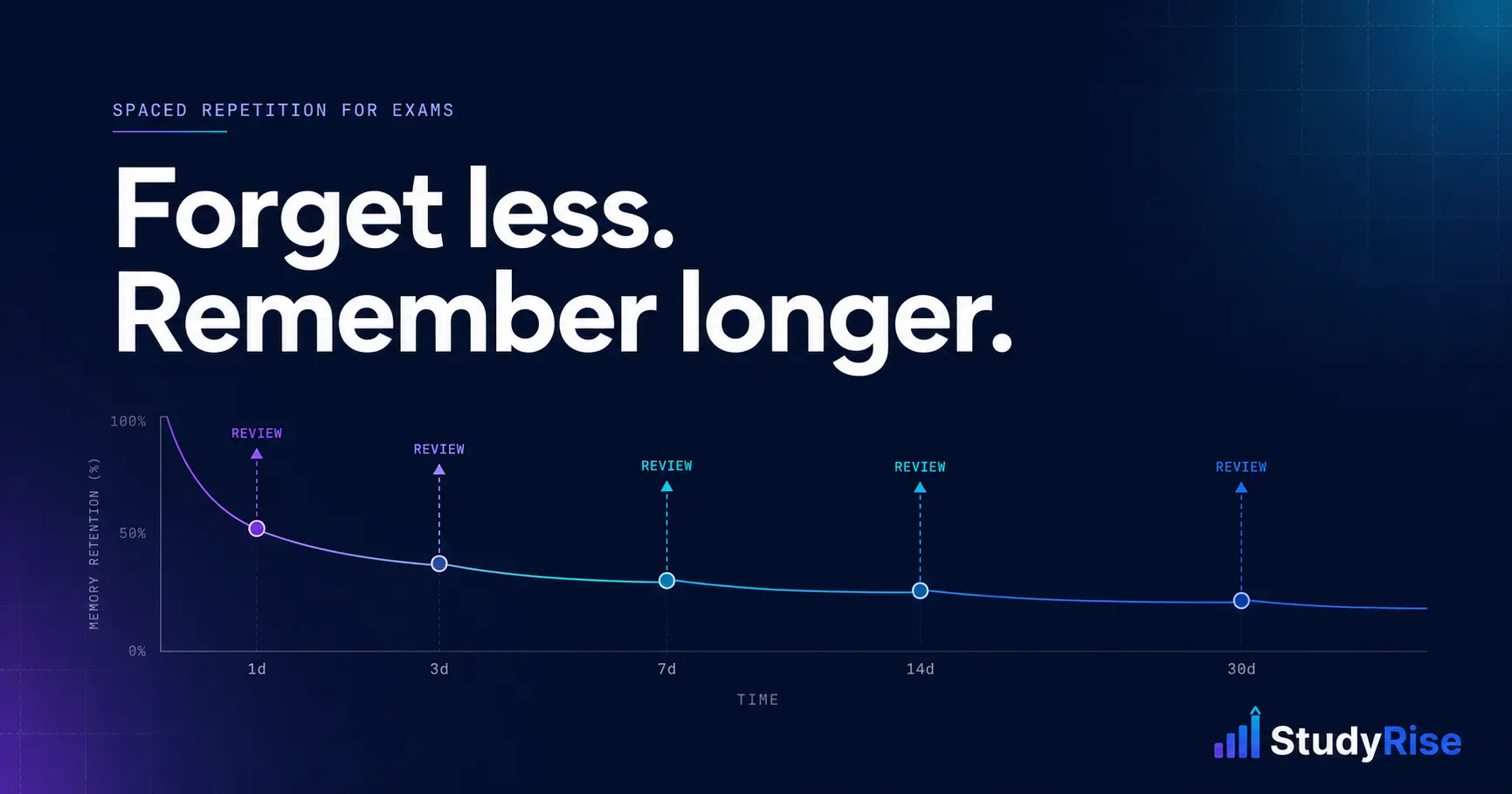
Spaced repetition works because forgetting is predictable, and a well-timed review interrupts it. In 1885 the German psychologist Hermann Ebbinghaus mapped how fast we lose new information (the "forgetting curve") in Memory: A Contribution to Experimental Psychology and showed memory decays quickly at first, then more slowly. Review just as the curve starts to dip, and you reset it; each reset leaves the memory more durable than the last.
There's a second reason, and it matters more than the spacing itself. The thing that strengthens a memory is the effort of pulling it back out: retrieving it after you've started to forget. That's why a review you can barely manage does more good than one that feels easy.
A little difficulty is the signal that learning is happening, not a sign you're behind. This is also why active recall, testing yourself rather than rereading, is built into the method, not an optional extra.
This is one of the most studied findings in all of learning science. A 2006 review by Cepeda and colleagues pooled 839 assessments across 317 experiments and found that spreading repeated study over time reliably produced better long-term memory than massing it together: for vocabulary, scientific terms, and the kind of dense factual material exams are built on.
The number that should set your schedule
Tie your first review to how far away the exam is. That single rule does more than any fixed calendar, and it comes from the most useful study on the topic. In a large 2008 experiment, Cepeda and colleagues taught more than 1,350 people a set of facts, had them review once after a gap, and tested them later. The best gap wasn't a fixed number of days. It scaled to the test date.
Their finding: for a test a few weeks away, the most effective gap before reviewing was roughly 20% of the time until the test. The paper maps a broad ridge of near-optimal gaps around that value rather than one exact figure, so treat it as a band rather than a setting. As the test moved further out, toward a year, the ideal gap shrank as a proportion, to around 5%. The practical takeaway is simple. The further off your exam, the longer you can wait before the first review; the closer it is, the tighter your reviews need to be.
Put a number on it. If your exam is 30 days out, that band lands your first review around day 5 to day 6 after learning a topic. Then you widen the gaps from there. You don't need to calculate this for every card. You just need to stop using the same fixed schedule whether your exam is next week or next year.
How to schedule your reviews
Build the schedule in three moves: start from a simple interval set, scale it to your exam date, then lay it out backward from the exam.
A simple starting schedule
If you want one template to begin with, review each topic the day after you learn it, then three days later, a week later, two weeks later, and a month later. It's easy to run by hand and it roughly approximates what the more sophisticated algorithms recommend for average material.
| When | What you do | Why |
|---|---|---|
| Day 0 | Learn the topic | First exposure: active, not passive |
| Day 1 | First recall test | Catch it before the steep early drop |
| Day 3 | Second recall test | Gap widens as the memory holds |
| Day 7 | Third recall test | A week out, recall is harder-won |
| Day 14 | Fourth recall test | Now it's sticking |
| Day 30 | Fifth recall test | Long interval; near exam-ready |
Be honest about what this template is: a fixed approximation. Adaptive tools adjust each interval based on how well you recalled the item: sooner when you struggle, later when it's easy. The fixed version is a fine place to start; it just won't personalise itself.
Scale the spacing to your exam date
Stretch or compress those intervals to fit your horizon. The 1–3–7–14–30 template assumes you have a couple of months. If your exam is eight weeks out, it fits comfortably and you can even add a final review in the last week. If it's three weeks out, pull everything in (maybe day one, day four, day ten, and day eighteen) so you still get four spaced passes before the exam.
The principle from the research holds at every horizon: the gap before the first review should be a slice of the total time you have, not a habit you copy from someone with a different deadline.
Plan backward from exam day, by priority
Start at the exam and work backward, and let priority decide how many reviews each topic gets. List your topics, then rate each one twice: how heavily the exam weights it, and how shaky you feel on it. A high-weight, low-confidence topic earns the most reviews; a topic you already know cold can coast on one or two.
For example, if cardiology is worth a big share of your exam and you're weak on it, schedule it on the full day-1, day-3, day-7, day-14, day-30 track. A topic you're confident in might only need a review at day 7 and again the week before. Spending equal time on everything is the most common way to under-prepare for what matters most.
Spaced repetition vs active recall
They're not rivals. They're two halves of one method. Active recall is what you do: retrieve the answer from memory, like a self-test. Spaced repetition is when you do it: at widening intervals. Spacing only pays off if each review is a genuine recall attempt.
This is the mistake that quietly wastes spaced study. If your "review" is rereading your notes or re-watching a lecture, you've spaced the wrong activity. You'll feel familiar with the material without being able to produce it under exam pressure. Familiarity isn't recall.
So make each scheduled review a retrieval. Cover your notes and write down everything you remember. Answer past-paper questions. Explain the concept aloud as if teaching it, then check what you missed. The schedule sets the timing; active recall is the work that the timing makes pay.
How much to review each day
The next two numbers are our editorial recommendation, not a research finding — no study sets a daily quota. For most students, 15 to 30 minutes of review a day is enough, alongside 10 to 20 new items. Consistency beats volume here: fifteen focused minutes every day will out-perform one long session a week, because the daily rhythm is what keeps each topic returning before it fades.
Watch one warning sign. If your daily review keeps creeping past about 45 minutes, you're adding new material faster than you can sustain the reviews for it. The fix isn't to push harder. It's to slow the intake until the backlog clears. A review queue you can finish is one you'll keep showing up for.
Doing it without flashcards (and for essay exams)
You don't need flashcards or any app to use spaced repetition. It's a scheduling habit, not a product. Flashcards are simply a convenient container for facts. The method works on anything you can test yourself on.
For fact-heavy material (drug doses, definitions, dates), short question-and-answer cards are efficient. For essay and concept exams, swap the format. Write recall prompts instead: "Explain how the kidney regulates blood pressure, from memory," or "Argue both sides of this case." Then put those prompts through the same spaced schedule, answering them in full each time. Past-paper questions work beautifully as spaced prompts, because they rehearse retrieval in the exact form the exam will demand.
By hand vs letting a planner do it
Doing this by hand works. It just gets fiddly fast. A flashcard app like Anki handles the per-card side well: it uses an algorithm to adjust each card's interval based on how you rate your recall, so weak cards come back sooner (checked 13 August 2026). If your material fits flashcards, that's a solid tool and worth using — and it does the card-level scheduling better than we do. StudyRise has no shared community decks and no per-card algorithm to tune; it schedules topics across a whole plan rather than individual cards, which is the right trade only if your problem is coverage across subjects rather than drilling one deck.
The gap is everything around the cards. Nothing in a flashcard deck plans your whole study schedule across several subjects, works backward from your real exam date, or tells you whether your pace is enough to be ready in time. That's the layer that stays manual, and the one that's tedious to maintain week after week as topics pile up and sessions slip.
That's the job StudyRise is built for: it takes your subjects and exam date and schedules the reviews for you, widening the gaps as you go and pulling weak topics back in sooner.
The day counts used as examples above illustrate the principle. They are not the intervals StudyRise schedules, which are worked out from your own exam date and how your reviews go.
It sits on top of a full study plan, so the reviews land inside a realistic week rather than a vacuum. Preparing for a specific licensing exam? The same spacing slots straight into a realistic AMC MCQ study timeline. If spacing several subjects by hand is what's stopped you before, this is the part worth handing off.
StudyRise builds the review schedule for every subject and reschedules it when you fall behind. Every new account gets 30 days of full access free, no card required. After that the planner, Today screen and study log stay free, with caps that in exam mode include three active subjects and 25 spaced-repetition records, alongside limits on plan tasks and monthly question logging.
Whichever route you take, the principle is the same one this whole guide rests on: learn it once, then meet it again on a widening schedule, testing yourself every time. Do that, and remembering stops being a matter of luck on the day.