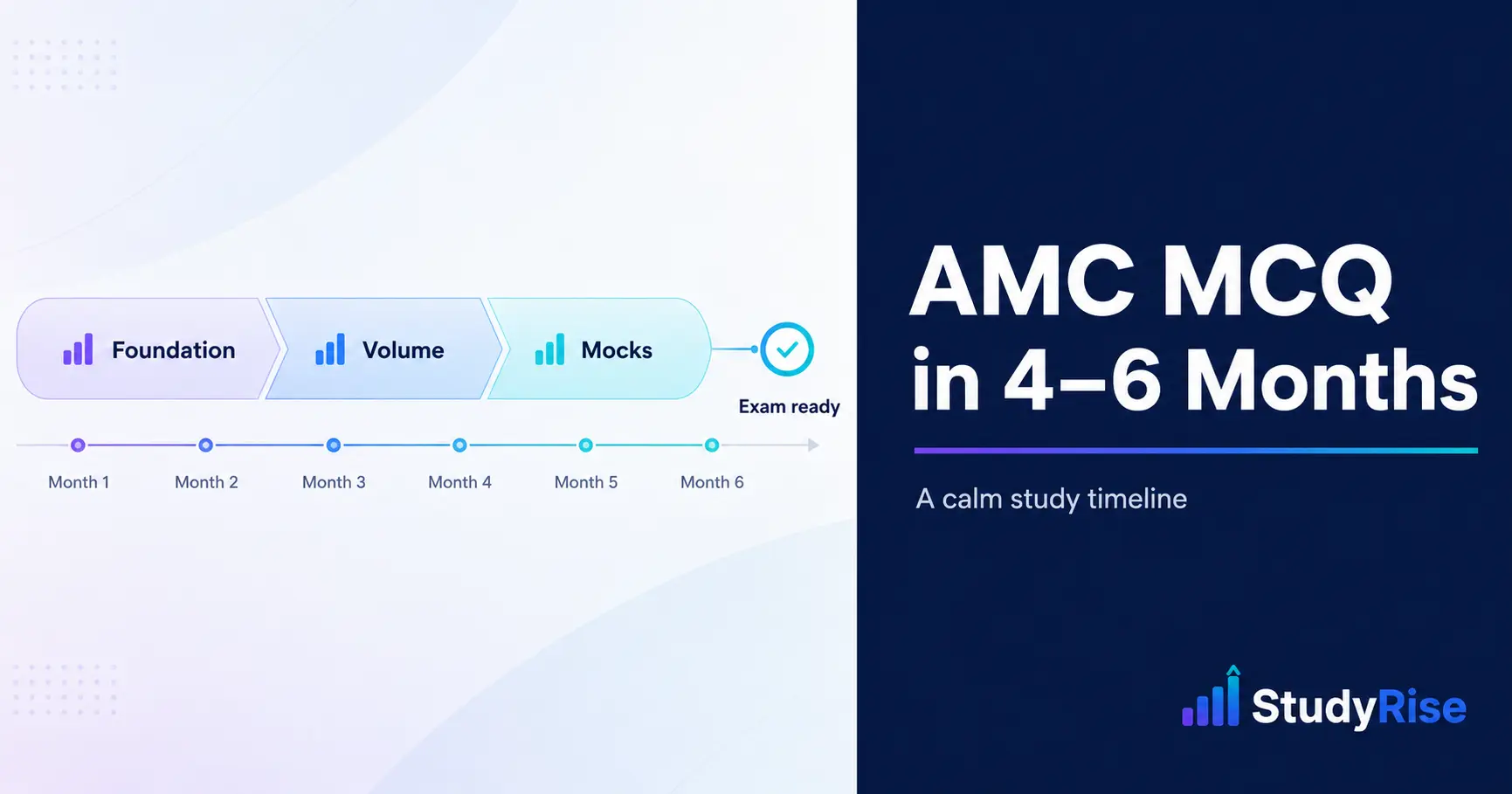
Three features of the AMC MCQ should shape every week of your AMC exam preparation: the adaptive format, the blueprint weighting, and the Australian clinical focus. The plan below turns those facts into dates, workload, and a weekly routine.
Build the plan in three phases
Choose the four-month or six-month column, then put the phase boundaries into your calendar before you choose resources.
| Phase | Four-month plan | Six-month plan |
|---|---|---|
| 1. Blueprint coverage | Weeks 1–5 | Weeks 1–8 |
| 2. Question-led learning | Weeks 6–12 | Weeks 9–18 |
| 3. Mocks + weak areas | Weeks 13–16 | Weeks 19–24 |
Set the plan up in this order:
- Choose a target sitting. If you have not booked yet, use a realistic target date. The AMC authorisation is valid for 12 months, but individual events and places still need to be scheduled. Read the booking guide and verify the current process on the AMC website.
- Count the hours you can protect in an ordinary week. Do not build from your best week. A plan you can run after a tiring shift is better than one that only works while you are on leave.
- Block the mock phase first. Reserve the final four weeks in a four-month plan or the final six weeks in a six-month plan. Divide the earlier weeks between coverage and question-led learning.
- Add one catch-up block each week. Leave it empty unless work moves. A full calendar has no recovery room.
Choose four months or six months
The AMC does not prescribe a preparation period. The ranges below are StudyRise planning guidance, not a pass guarantee.
| Starting point | Suggested runway | Weekly capacity |
|---|---|---|
| Strong, current clinical foundation | About 4 months | Roughly 18–25 focused hours |
| Working shifts or needing a broad refresh | About 6 months | Roughly 12–18 focused hours |
| Under 12 hours or large foundation gaps | Use a later date | More than 6 months may be safer |
Do a diagnostic block before fixing the date. If errors are spread across every patient group, choose the longer runway. If most errors are concentrated in one or two areas and your clinical reasoning is current, the shorter plan may be workable.
Divide your study time by the official blueprint
The current AMC MCQ Examination Specifications (V8) divide the 150 questions across six patient groups. Start with the same proportions in your weekly plan.
| Patient group | Official weighting | In a 20-hour week |
|---|---|---|
| Adult Health — Medicine | 30% | About 6 hours |
| Adult Health — Surgery | 20% | About 4 hours |
| Women's Health | 12.5% | About 2.5 hours |
| Child Health | 12.5% | About 2.5 hours |
| Mental Health | 12.5% | About 2.5 hours |
| Population Health & Ethics | 12.5% | About 2.5 hours |
This is your starting budget, not a rule you must obey forever. After two weeks of mixed questions, move some time towards repeated weak areas. Keep the overall weighting visible so a favourite subject does not quietly take over the plan.
Practise for the exam you will sit
The current AMC format changes how you should practise:
- 150 questions in 3.5 hours: that is an average of 84 seconds per item. Full mocks should use the same limit.
- Computer Adaptive Test: the next question becomes easier or harder according to the previous response. Your result is an ability estimate, not a simple raw percentage.
- No return to earlier questions: you must answer before moving on and cannot later change the response. Practise making a decision without relying on a review screen.
- Complete all 150 items: the AMC says marks are not deducted for incorrect answers and warns that an incomplete attempt may produce insufficient data for a result.
A normal question bank cannot reproduce the adaptive algorithm. That is fine. Use it to train single-best-answer reasoning, pace, and the discipline to commit once. For a fuller explanation of the format and the 2026 pass-standard change, use the dedicated guides rather than building your plan around a guessed raw score.
Phase 1: cover the blueprint once
Give phase 1 five weeks in the four-month plan or eight weeks in the six-month plan. Your goal is not perfect notes. It is to see every patient group, identify gaps, and build enough context for mixed questions.
Start practice questions now. Use a small topic-linked block after each study session and review it before moving on. Waiting until every subject feels complete is the fastest way to delay the most useful part of preparation.
Keep one error log with three labels: knowledge gap, reasoning error, or rushed reading. Add only the correction you need to recall next time. Long copied explanations create work without showing you what went wrong.
Phase 1 is complete when every patient group has been covered once, you have started Australian-specific reading, and you can move into mixed blocks without seeing whole subjects for the first time.
Phase 2: make questions the main learning tool
In phase 2, use roughly two-thirds of your study time for questions and review. Use the remaining third for targeted reading, spaced reviews, and the gaps exposed by the questions. This split is StudyRise's recommendation, not an AMC requirement.
Move from topic blocks to mixed blocks. Random switching is closer to the real exam, where items are spread across the blueprint. Review every wrong answer and every correct guess. If you cannot explain why the best option beats the plausible alternatives, the item is not finished.
One completed question bank beats three half-used subscriptions. Choose one reputable bank, finish it, and revisit your weakest groups. Add the AMC's official preparation app for calibration rather than treating it as a full curriculum.
Choose resources for a job, not a collection
The resource list should stay short. These are StudyRise's editorial verdicts based on the current official material:
| Resource | StudyRise verdict | How to use it |
|---|---|---|
| AMC specifications | Mandatory first read | Confirm the current format, blueprint, rules, and sample items |
| AMC preparation app | Best official calibration set | Use all 210 questions once your authorisation gives you access |
| Australian Prescriber | Best free therapy check | Read only when a management question exposes a gap |
| Therapeutic Guidelines | Strong point-of-care reference | Check Australian management; do not read cover to cover |
| RACGP Red Book | Use for prevention and screening | Target recommendations you repeatedly miss |
| Australian Immunisation Handbook | Use for vaccination decisions | Check current schedules, risk groups, and catch-up advice |
Avoid reconstructed AMC papers as a main source. The AMC specifications warn that circulated reconstructions contain incorrect stems and responses and can give a distorted picture of the real exam. That is a stronger reason to reject a resource than any online popularity score.
StudyRise builds a dated plan from your exam date and weekly availability, schedules spaced reviews, tracks question practice and mocks, and lets you reflow remaining work when your dates change. Every new account gets 30 days of full access free, no card required.
Phase 3: run timed mocks and repair weak areas
Use the final four weeks of a four-month plan or the final six weeks of a six-month plan for exam rehearsal. Sit a full-length mock every 7–14 days, depending on how much time you need to review it properly. More mocks are not automatically better. One honest caveat if you plan to run this phase inside StudyRise: a free account records one mock per calendar month, so this rehearsal cadence needs a paid plan. Sitting the extra mocks elsewhere does not get you round it — the cap is on how many results you can record, not on where you sat them.
Recreate the current conditions: 150 questions, 3.5 hours, one answer before moving on, and no return to earlier items. Then review the mock on the next study day. Sort each error by patient group and by cause. Repeated errors decide the next week's work; the total score does not.
Keep short spaced reviews running, especially for material from the first month. Stop adding new resources. The final phase is for reducing known errors and making your pace predictable.
Copy this 18-hour question-phase week
This example suits someone studying around work. Adjust the question counts down if review is taking longer; never protect the number at the expense of understanding.
| Day | Work | Time |
|---|---|---|
| Monday | 30 medicine-weighted questions + review | 2.5 hours |
| Tuesday | 30 surgery-weighted questions + review | 2.5 hours |
| Wednesday | Weak-topic reading + spaced review | 2 hours |
| Thursday | 40 mixed questions + review | 3 hours |
| Friday | 30 questions from the four smaller groups | 2.5 hours |
| Saturday | 75-question timed block + full review | 4.5 hours |
| Sunday | Catch-up or light error-log review | 1 hour |
Avoid these five planning mistakes
- Waiting to feel ready for questions. Start topic-linked questions in phase 1. Readiness comes from finding and repairing errors.
- Giving every patient group equal time. Begin with the official weighting, then adjust for measured weaknesses.
- Collecting resources. One finished bank, the official app, and a few targeted Australian references are enough for a coherent plan.
- Planning from an ideal week. Use the hours you can protect while working, commuting, and managing family responsibilities. Keep a catch-up block.
- Reviewing passively. Re-reading an explanation is not the same as recalling the decision. Close the page and explain why the correct option wins.
Build it by hand or use StudyRise
A spreadsheet and calendar are enough. Create three phase bands, divide weekly hours by the blueprint, place your question bank and mocks, and review the plan every Sunday. When a week slips, move incomplete work without compressing the final mock phase.
The trade-off is maintenance. Every moved date changes the remaining workload. If you prefer to automate that part, the StudyRise AMC MCQ study planner builds a dated plan from your exam date and availability, tracks coverage and readiness, schedules reviews, and lets you reflow remaining tasks when the plan changes. The Exam Mode guide shows the setup.
Whichever tool you choose, do the first four actions now: set the target date, choose the runway, reserve the mock phase, and schedule this week's first question block. A useful plan is not the one with the most detail. It is the one that tells you what to do next and still works after an imperfect week.
Official sources checked
Exam facts in this guide were checked on 12 August 2026 against the AMC MCQ examination page, AMC MCQ Examination Specifications V8, and the AMC preparation app page. Study periods, weekly hours, phase boundaries, and resource verdicts are StudyRise editorial recommendations, not AMC rules.