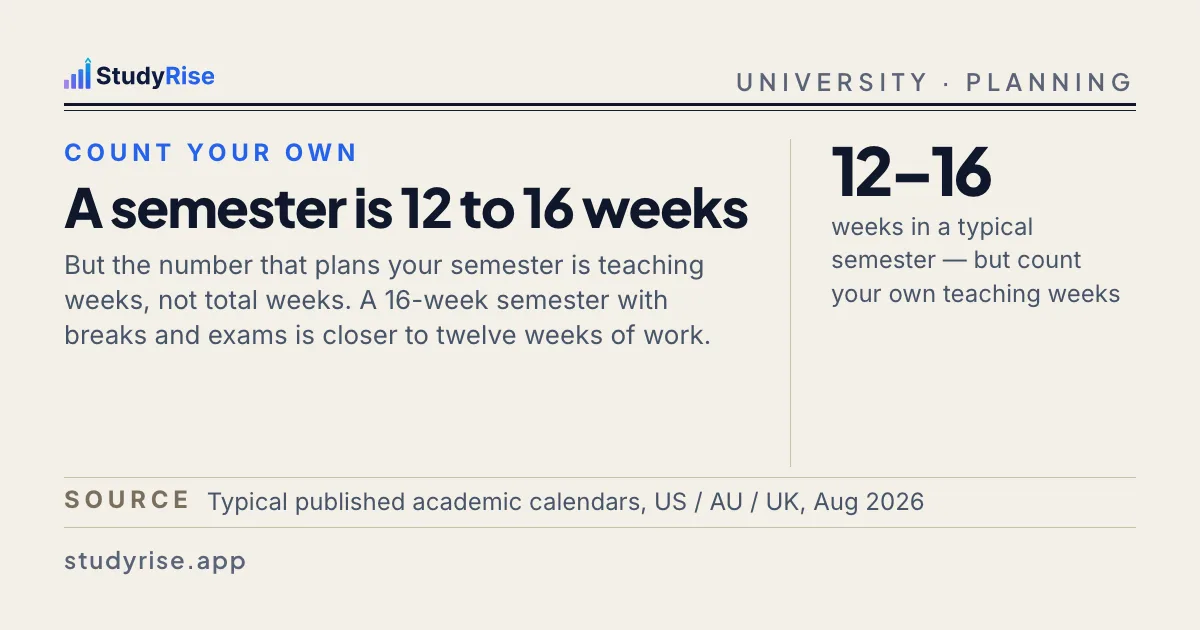
If you are here to put a number in a planner, use 12 to 16 and then go and find your real one. The spread between institutions is wide enough that a generic figure will misprice your semester by a fortnight, and a fortnight is the difference between a calm revision period and a bad one.
The usual range, and why it varies
| Where | Typical semester | Shape |
|---|---|---|
| United States | 15–16 weeks | Teaching plus a finals week, usually counted together |
| Australia | 12–13 teaching weeks | Plus a study break and a separate exam period |
| United Kingdom | 11–15 weeks | Varies most; many universities use terms instead of semesters |
Treat those as typical figures only. Institutions set their own calendars, faculties inside one institution sometimes differ, and a trimester or quarter system changes the arithmetic completely. This is why the answer to the question is a method. The number has to come off your own calendar.
Count your own, in five minutes
Open your university's academic calendar. It is usually published a year ahead under a name like "key dates", "principal dates" or "academic calendar". Then write down four things:
- Teaching weeks. First day of classes to last day of classes, minus any mid-semester break.
- Break weeks. Reading week, mid-semester break, public holidays that fall on your class days.
- Study or revision period. The gap between the last class and the first exam.
- Examination period. Its first and last day, because your own exam dates are published later.
Do this in week one, before the work starts arriving. Students who do it in week seven usually do it because something has already gone wrong.
Why teaching weeks are the number that matters
Total semester length flatters you. A 16-week semester with a reading week, four public holidays and a two-week exam period is not sixteen weeks of work; it is closer to twelve, and every assessment deadline sits inside those twelve.
Plan against teaching weeks and treat the study period as revision rather than as catch-up. The most common semester failure is arriving at the study period with new material still unlearned, which turns revision time into first-pass learning and leaves nothing for practice.
One more reason to know the number precisely: assessment clusters. Most courses put major assessments in weeks 6 to 8 and again in weeks 11 to 13, so several units peak simultaneously. If you know your teaching weeks you can see the collision on a calendar in week one instead of discovering it in week six. Our guide to planning a university semester walks through that collision map in detail.
What a semester unit or credit means
A semester unit, credit or credit point is a measure of workload. Time in class is only one component of it. A typical full-time load is four units in a semester, and each unit usually expects several hours of independent work per week on top of contact hours.
The practical translation: if a unit expects around ten hours a week including classes, four units is a full-time job. Students routinely plan as though the timetabled hours are the commitment and the rest is spare time, which is where the semester quietly goes wrong. Check your own institution's stated expected workload per unit, because it is usually published and rarely read.
Turn the number into a plan
- Map every assessment onto the week it is due, for every unit at once. One calendar, all units. The point is to see the pile-ups.
- Work backwards from each deadline instead of forwards from today. An essay due in week 9 needs a reading block in week 6 and a draft in week 8, and those belong in the calendar now.
- Leave the last teaching week nearly empty. Something will slip, and a week with no planned work is the only insurance that costs nothing.
If your semester has already started and this list feels late, it is not. Reallocating twelve weeks in week three is ordinary planning; reallocating four weeks in week nine is triage, and our guide to catching up when you are behind covers that case honestly.
Summer, winter and short semesters
Intensive semesters compress the same unit content into roughly a third of the weeks, often four to six. The credit value does not change, so the weekly workload roughly triples.
Take one unit in a short semester and leave the second for a full-length one. The compressed format removes the slack that lets you recover from a bad week, and there is no mid-semester break to absorb an illness. It is a good way to clear a prerequisite and a poor way to carry a full load.
How we checked
The ranges in this guide are typical published patterns across institutions in the United States, Australia and the United Kingdom as at 14 August 2026, and they are offered as orientation only. There is no single governing definition of semester length: each institution publishes its own academic calendar and its own expected workload per unit, and those documents are authoritative for you. The planning advice is StudyRise editorial judgement.