Coaching pages, recall papers and confident forum threads each describe the AMC syllabus in slightly different terms, which makes the exam feel like something you have to reverse-engineer from other people's memories.
You do not. The AMC publishes a document called the MCQ Examination Specifications, currently at version 8, dated September 2025. It states the blueprint, the question types, the scoring model and the rules of the sitting. Reading it takes twenty minutes and settles most of the arguments you will find online, including a couple where the popular answer is out of date.
The syllabus is a table, and the AMC prints it
The specification describes the MCQ as a test of the principles and practice of medicine across Adult Health (Medicine), Adult Health (Surgery), Women's Health (Obstetrics and Gynaecology), Child Health, Mental Health, and Population Health and Ethics. The 150 questions are blueprinted across those groups in fixed proportions.
| Patient group | Share of the blueprint | What it means for your weeks |
|---|---|---|
| Adult Health — Medicine | 30% | The largest single block by a wide margin |
| Adult Health — Surgery | 20% | Second largest, and routinely under-prepared |
| Women's Health (Obs & Gyn) | 12.5% | Obstetrics and gynaecology share the one allocation |
| Child Health | 12.5% | Fetal development through to end of adolescence |
| Mental Health | 12.5% | All age groups, including addiction |
| Population Health & Ethics | 12.5% | Screening, epidemiology, consent, the Australian system |
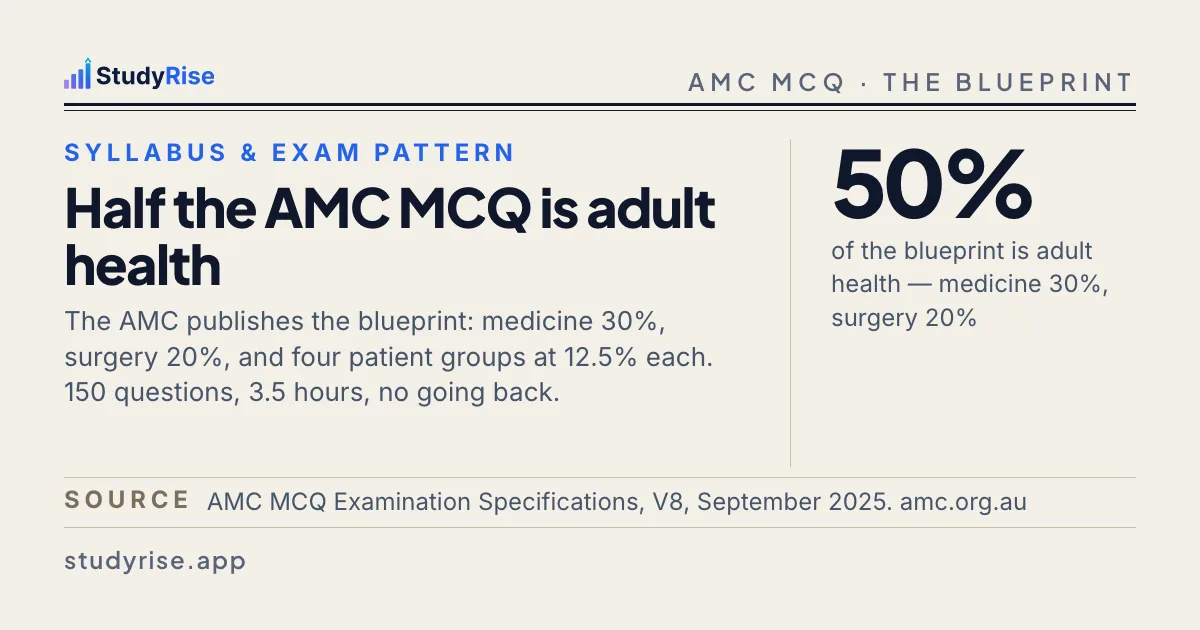
Two things follow from that table. The first is arithmetic: adult medicine and surgery are half the examination between them, so a study plan that gives them half its weeks is simply matching the exam, and one that spends its best months on a favourite subject is quietly betting against the blueprint.
The second is subtler. Population Health and Ethics carries the same weight as child health, which surprises people who file it under "the soft one". The specification defines it as screening, surveillance, vaccination programmes, epidemiology and legislation, plus professional behaviour, confidentiality, informed consent and the regulation of Australian health care. That is an eighth of the marks, and it rewards reading rather than clinical instinct, which makes it one of the more winnable eighths on the paper.
Across the examination the AMC says a satisfactory candidate needs pathogenesis, clinical features, investigative findings, differential diagnosis, and management and treatment. The standard is pinned explicitly: the level of a graduating final-year Australian medical student about to begin the intern year.
Not a specialist, and not a final-year student anywhere. The specification also notes that the majority of questions reflect common clinical conditions in the Australian community, which is the quiet reason so many well-prepared international graduates find the exam foreign in a way they did not expect.
What each question asks of you
Questions carry a second classification alongside the patient group, and it gets far less attention than the percentages. The AMC sorts every item under one of three clinician tasks.
- Data gathering. History taking, mental state examination, physical examination, laboratory testing, imaging and other investigations.
- Data interpretation and synthesis. Clinical reasoning, problem identification, setting priorities, risk stratification, and forming a differential and specific diagnosis.
- Management. Education and health promotion, counselling, drug and non-drug therapy, surgical and radiological interventions, complications, rehabilitation, palliative care, and family and community care.
This is a useful diagnostic for your own revision. If your notes are lists of diseases with their features, you are prepared for the first task and thinly prepared for the other two.
The specification is direct about it: the examination tests a candidate's capacity for reasoning rather than rote learning, and it singles out items that are critical to patient safety, related to life-threatening illness, or important to public health. Those are the questions that separate people, and they are almost never answered by recall alone.
The exam pattern: 150 questions, 3.5 hours, and a test that watches you
The AMC MCQ is a computer adaptive test. Your first question is selected at random from the item pool. From then on the machine reacts to you: answer correctly and the next question is harder, answer incorrectly and the next is easier. After every response the software recalculates an estimate of your ability, and the estimate gets more precise as the questions home in on your level.
Everything in the format follows from that. Each question is A-type, one correct response from five options, and the AMC notes that other options may be partially correct while only one is best. Some questions are built on an image, an X-ray, ECG, scan or clinical photograph. Items are randomised across the blueprint, so the patient groups arrive shuffled rather than in tidy sections, and you never get a run of paediatrics to settle into.
The timing is worth doing on paper. Three and a half hours is 210 minutes, and 210 minutes across 150 questions is 84 seconds per question, including the ones with an ECG attached. There is a timer in the examination platform, and the AMC's advice is to pace yourself. That number is the entire argument for practising under time rather than in comfortable untimed blocks.
The rule that catches people: no skipping, no going back
Here is the part that surprises repeat candidates, and it is stated plainly in the specification. Each question must be answered before another will be administered. You cannot leave one blank and progress.
Once you have answered, you cannot go back to a previous question and change your response. The AMC explicitly flags this as a change for anyone who has attempted the MCQ before, introduced to improve question security and to bring the examination into line with other adaptive tests internationally.
If your exam technique is the one most of us learned at medical school (sweep the paper, answer what you know, flag the rest, return with whatever time is left), it does not survive contact with this format. There is no sweep. There is one question, then the next one, chosen because of what you just did.
How the score is built, and why counting correct answers tells you nothing
The AMC is blunt that your result is not simply the number of questions you got right. Two candidates with identical correct counts can finish with different scores, because the adaptive engine may have fed one of them consistently harder items.
What is measured is your ability level, which is then reported on a 0 to 500 scale where 250 is described as the pass mark. A single cut score applies to the whole examination, so you are measured against the standard rather than against the people who sat on the same day.
From 2026 the AMC is introducing a slight increase to that pass standard, integrated into the same 0 to 500 scale, which our guide to the 2026 pass-standard change covers in detail. Results are released through your AMC account at 4pm on the Friday three weeks after the examination event, along with a transcript and feedback on your performance.
One correction worth making, because it circulates widely and we had repeated it ourselves: summaries describing "120 scored questions and 30 unscored pilot items" do not match what the AMC currently publishes.
Its MCQ page states that you are expected to complete all 150 scored items, and the specification says at least half the questions come from a pool of previously calibrated items while the remainder are new questions that are inspected and calibrated before being used for scoring. Where a dated, versioned specification and a popular summary disagree, the specification wins.
What to study from, according to the people who write the questions
The specification contains a section that reads like a warning, because it is one. The AMC says reconstructed examination papers circulating online are claimed to be accurate reproductions, that it has been given copies, and that it found many of the question stems and responses to be incorrect.
Candidates who prepare from them may end up with a distorted impression of both format and content. That is the examiner telling you that the recall bank you were sent is partly wrong and you cannot tell which parts.
What the AMC does point candidates toward is more interesting than the usual textbook advice. It suggests care with major reference textbooks, on the grounds that questions are oriented to common clinical applications, differential diagnosis and therapeutics, and it recommends review articles in Australian general practice journals for exactly that reason.
Since April 2025 it has also run a free MCQ preparation app built with eMedici, holding 210 practice questions with feedback for candidates who have purchased an MCQ authorisation (checked 18 August 2026). Free official practice questions are worth using before anything you pay for.
If the acronyms are still blurred, our explainer on what AMC stands for separates the council from the regulator, and how to become a doctor in Australia maps where this examination sits in the wider pathway.
Turning a blueprint into a set of weeks
A syllabus is only useful once it becomes a schedule, and this is where most preparation quietly fails. A schedule needs a fixed end point, which means choosing and booking an exam date — less obvious than it sounds, since the AMC issues a 12-month authorisation rather than a calendar.
The blueprint hands you the proportions, so the first pass is straightforward: divide your available weeks so adult medicine and surgery take about half, and the four smaller groups take an eighth each. Doing that badly is still better than not doing it, since the alternative is study time allocated by what feels comfortable on a Sunday evening.
The harder problem is that the blueprint is wide. Covering population health in month one is no use if it has faded by the exam in month six, and long preparations lose material at roughly the rate they gain it unless something forces revisiting.
That is what spaced repetition is for, and why a realistic AMC MCQ study plan schedules return visits rather than a single sweep. A sustainable daily question load keeps the whole thing survivable on ordinary weeks, which is most weeks.
StudyRise's AMC study planner builds a plan on the blueprint weights above and gives you a readiness number as you work. Seeing which of the six groups is drifting — per-domain blueprint coverage — is part of StudyRise Pro.
It reschedules around the weeks that go wrong, and every six-month preparation has several. None of it is required to pass, and doctors have passed with a paper diary and considerable stubbornness. What a plan buys you is not having to hold the whole blueprint in your head in month four.