"How many questions a day should I do for the AMC MCQ?" is one of the most common questions candidates ask, and it's usually the wrong one to start with. The honest answer is that no single number fits everyone, and chasing a big daily tally is one of the easiest ways to feel productive while learning very little. A better question is: how many questions can I review properly today?
This article gives you a realistic daily range, shows how that range should shift as you move through your preparation, and explains why the review (not the count) is the part that moves your score. If you want the full picture of how questions fit into a whole timeline, this sits inside our complete AMC exam preparation plan.
Why "questions per day" is the wrong first question
The appeal of a daily question target is obvious: it's a clean, countable goal you can tick off. The problem is that the AMC MCQ doesn't reward exposure. It rewards learning.
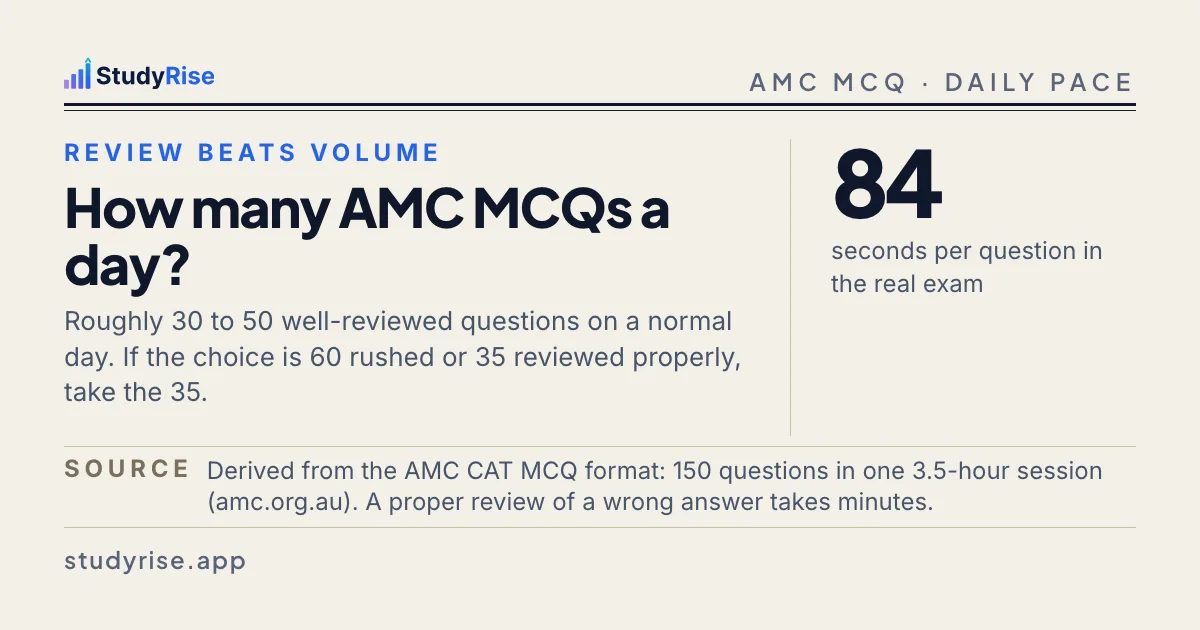
It's a Computer Adaptive Test: the AMC's MCQ Examination Specifications (V8, September 2025) state that a correct answer brings a harder question next and an incorrect one brings an easier question, so your score is an ability estimate rather than a raw count of items seen. The same document states that marks are not deducted for incorrect answers, which is why leaving an unavoidable guess costs you nothing — and that you cannot skip a question and return to it, so each item has to be answered as it arrives. That is what makes pacing binding rather than advisory: 150 questions in one 3.5-hour session works out at about 84 seconds each.
Grinding through hundreds of questions you barely understand doesn't move that ability estimate; understanding the ones you get wrong does.
Fixating on a number also creates a perverse incentive. When your goal is "80 questions today," and you're running out of evening, the tempting shortcut is to rush the review (glance at the explanation, nod, move on) just to keep the pace up. That's exactly backwards. The single most valuable minutes of your study day are the ones spent working out why you got something wrong, and a daily quota quietly pressures you to skip them.
So treat the count as a byproduct, not a target. Decide how much time you can protect for questions, work at a pace that lets you review each one fully, and let the number land where it lands. Some days that's 50; some days a hard set of 30 with careful review teaches you more. The scoreboard that matters isn't questions per day. It's whether you're finishing your bank and closing your weak areas.
A sustainable daily range
With that caveat in place, people still want a starting point, and a range is genuinely useful for planning your week. For most candidates on a normal study day, 30 to 50 well-reviewed questions is a sustainable target. That's enough to make steady progress through a bank without turning review into a rushed afterthought, and it's a load you can hold for months rather than for one heroic week.
Where you sit in that range depends on two things. The first is how much time you can protect. Two to three focused hours on a weekday is very different from a rare free day, and your question count should breathe with that. The second is how close the exam is: with months to go, the lower end keeps things sustainable; in the final stretch, you'll lean higher and add longer weekend blocks to build stamina.
Two practical notes. Doing questions in mixed blocks, jumping between patient groups the way the real exam does, is more useful than marching through one subject at a time, because it rehearses the switching the CAT demands.
A smaller number done in timed conditions, with an answer committed to every item, is often worth more than a larger untimed set. The range is a guide, not a rule; the moment hitting the number costs you the quality of your review, the number is too high for that day.
Coverage phase vs question phase vs mocks
Your daily question count shouldn't be constant across your whole preparation. It should rise as you move through the phases. A good AMC MCQ plan moves through three of them, and questions play a different role in each.
| Phase | Role of questions | Typical daily volume |
|---|---|---|
| Coverage | A check on your reading | Low: a handful per topic as you cover it |
| Question phase | The main engine of learning | Highest: roughly 40–50 on a normal day |
| Mocks & revision | Timed rehearsal + gap-fixing | Mock-dominated: raw daily count drops between mocks |
In the coverage phase, your main job is seeing the whole blueprint once, in the right proportions. Questions here are a small part of the day: a way to check whether the reading landed, not the reading itself. If you're doing hundreds of questions a day this early, you've probably started the question phase without finishing coverage.
In the question phase, questions become your primary study tool rather than a test you take at the end. This is where a normal day sits at the top of the range, because banks surface what you don't know far faster than rereading ever will. The goal for this phase is concrete: finish one full bank, with your weakest groups seen a second time.
In the final weeks, the centre of gravity shifts again, to full-length, timed mocks. On a mock day you might do a whole paper in one sitting; on the days between, your raw new-question count often falls, because you're spending time reviewing the mock by patient group and patching the gaps it exposed. Counting "questions per day" in this phase can be misleading: a day spent dissecting one mock can be worth more than a day of fresh questions.
StudyRise turns your exam date into a day-by-day schedule that paces your whole question bank across the weeks you have, so the daily target adjusts by phase, and reschedules when you fall behind. Every new account gets 30 days of full access free, no card required.
Reviewing is the real work
If there's one idea to take from this article, it's this: the review is the study, and the questions are just the prompt. Answering a question tells you whether you know something. Reviewing it is where you learn, and it's the part that turns a wrong answer into a mark you'll get right on the day.
The rule that protects your progress is simple: never move on from a question you got wrong until you can explain the right answer from memory. Not "I recognise it now" (that's recognition, and recognition fades). Explaining it means you could reconstruct the reasoning a week later without the explanation in front of you. That test is deliberately hard, because it's the difference between recognising an answer and owning it.
Pay special attention to the "what would you do next" and management-style questions. The blueprint classifies items by clinician task — data gathering, interpretation and synthesis, and management — so management decisions recur across every patient group. The AMC publishes no weighting by question type, so treat that as a reason for emphasis, not as arithmetic about marks.
Reviewing this way takes time, often more time than answering did. In the exam you'll have around 84 seconds per question, but in practice a proper review of a wrong answer can run several minutes, and that's exactly as it should be. This is precisely why counting attempted questions is the wrong metric and counting reviewed questions is the right one. Thirty questions reviewed to the point where you can explain every mistake will teach you more than sixty skimmed.
The final piece is making the corrections stick. A rule you understood today will quietly decay unless it comes back. Feed each correction into a spaced-repetition schedule so it resurfaces at expanding intervals: days, then a week or two later, before it fades. Done consistently, this is what stops you re-learning the same mistakes in month three that you first met in month one.
A worked weekly example
Numbers are easier to judge in context, so here's what a realistic mid-plan week might look like for someone in the question phase studying around 15–18 hours. Notice how the count varies by day, how review and rest are built in, and how the weekend block builds endurance toward mocks.
| Day | Session | Focus |
|---|---|---|
| Mon | 40 mixed questions + full review | Medicine-weighted block |
| Tue | 40 mixed questions + full review | Medicine / surgery block |
| Wed | Spaced reviews + weak-topic read | No new questions: patch the gaps |
| Thu | 45 mixed questions + full review | Surgery / women's & child health |
| Fri | 40 mixed questions + full review | Mental health / population health |
| Sat | Longer block: 70–80 questions | Build endurance toward mocks |
| Sun | Rest or light spaced review | Recovery keeps the pace sustainable |
The exact figures matter far less than the shape. There's no day where the goal is simply "do as many as possible"; every question day pairs a batch with a full review, one midweek day carries no new questions at all so the corrections can consolidate, and one day is real rest. Add it up and it's a sustainable rhythm you could hold for a couple of months, which is the point, because that's how long the question phase lasts.
When to push harder or ease off
A sustainable range is the default, not a straitjacket. There are times to push the number up, and times when easing off is the smarter move, and knowing which is which keeps you off the two classic failure paths: burning out early, or drifting and running out of road.
Push harder when the maths says you're behind (you've done the honest arithmetic and you won't finish your bank at the current pace before the exam), or when a diagnostic mock keeps flagging the same weak group and you have the time and energy to attack it. A light, high-energy day is also a fine time to bank a longer block.
The test for whether a push is real: you can still review every question to the same standard. If the extra questions come at the cost of rushed review, you haven't pushed harder. You've just done more badly.
Ease off when review quality is slipping, when your accuracy is drifting down while your hours climb (a classic sign of fatigue, not laziness), or when life simply gets in the way for a stretch.
Cutting your daily number in half for a few days to protect the quality of your review is almost always the right call over pushing through and learning nothing. A missed target is recoverable; weeks of shallow, un-retained practice are the thing that sinks a plan.
By hand vs a planner
You can absolutely manage all of this by hand. Take the size of your question bank, divide it across the weeks you have until the exam, and you get a rough daily figure to aim at. Sketch the phases, hold the review discipline, and tick off sessions as you go. Plenty of people run their whole preparation from a spreadsheet, and it works, right up until real life moves a few sessions.
That's where the manual approach gets tedious. Miss three days to a run of shifts and the neat daily figure is suddenly wrong; keeping the bank, the phase shifts, the mocks, and your spaced reviews all in proportion across five months is fiddly to maintain by hand, and it's the part most people quietly stop doing.
That rebalancing is the job a planner is built for. StudyRise takes your exam date and lays out the whole timeline, paces your bank across the weeks so you get a daily range instead of a number you invented, schedules your spaced reviews automatically, and reshuffles the plan when you fall behind rather than leaving you to redraw the grid.
If maintaining the schedule by hand is what's stopped you before, that's the part worth handing off: it lets you keep your attention where it belongs, on reviewing questions rather than re-planning them.
Chase the review, not the number. Finish one full bank with your weak areas seen twice, and the daily count takes care of itself. Start free and let the plan pace it for you.