Apply first, book second. The AMC CAT MCQ is not run like a school exam with two fixed sittings a year, which is why the calendars circulating online promise a schedule the Australian Medical Council does not publish in that form.
Getting that order right changes when you should book, and it changes your study plan, because the two turn out to be the same decision.
Why there's no simple list of AMC exam dates
You do not pick a date and then apply. You apply first. The AMC assesses your application, you pay, and you receive an authorisation — permission to sit one AMC CAT MCQ examination event. Only then do you go to Pearson VUE, who deliver the exam, and choose from the events that still have seats.
So "the AMC exam dates" is two lists overlaid: the examination events the AMC is running, and the subset of those that fall inside your authorisation window and still have capacity at a venue you can reach. The second list is personal to you, which is why no generic calendar can answer the question properly. Always take the current events from the AMC's own examination events page.
The 12-month clock most candidates start too early
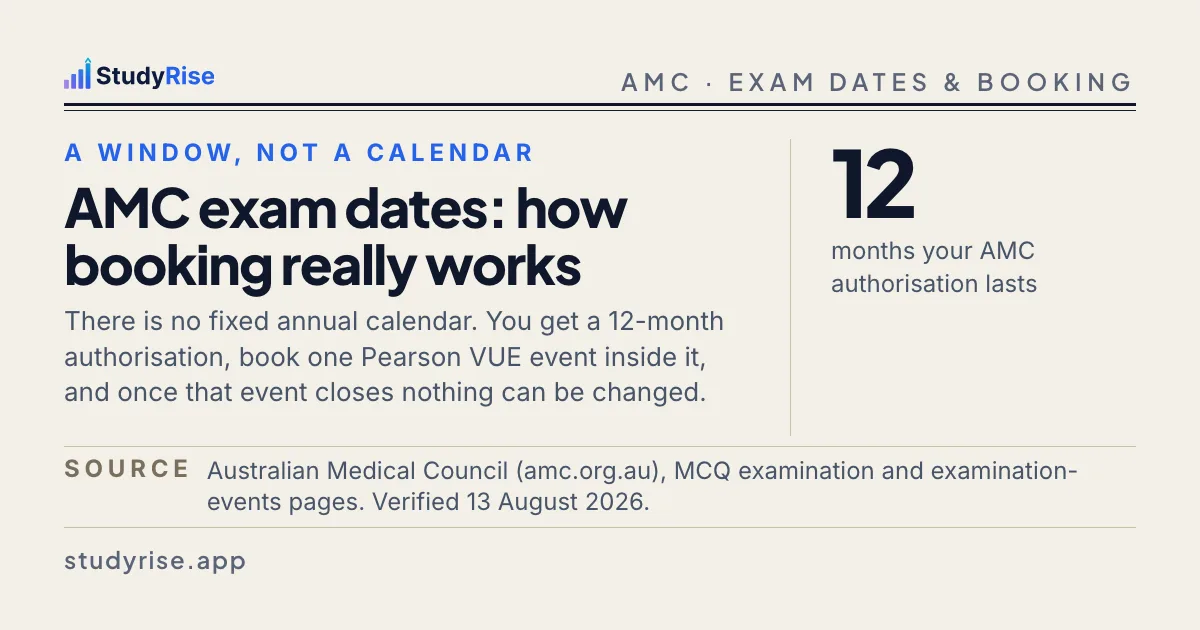
This is the fact that should shape your planning, and it is the one most often missed: the authorisation runs for 12 months. The AMC's own wording is that it is "valid for 12 months to schedule an AMC CAT MCQ examination event" (AMC MCQ examination page, checked 13 August 2026).
Inside that window you also need to sit: the AMC's cancellation grounds are written around circumstances that prevent you "from sitting a AMC CAT MCQ examination within your 12-month authorisation period". Miss it and you reapply and pay again. The AMC does not publish what date starts the clock, so take the start from your own authorisation letter rather than assuming it runs from the day you paid.
Read that against how long preparation takes. Most candidates need four to six months of consistent study for the AMC MCQ; our AMC study plan works that through phase by phase. If you pay for authorisation the moment you are eligible and then spend five months deciding how to start, you have burned nearly half the window, and you will be choosing from whatever events are left rather than the one that suits you.
How booking works, step by step
Scheduling happens with Pearson VUE, not the AMC, and seats are allocated first come, first served at venues with limited capacity. The AMC's own guidance is blunt about the consequence: it is vital to schedule as soon as possible within the authorisation period to secure a seat.
Those two rules pull against each other, and that tension is the whole planning problem. The seat rewards booking early. The 12-month clock punishes it. The resolution is in when to start the clock below — and it is not a compromise between the two so much as a change in what you do first.
One practical note for the day itself: the AMC states that "at all venues, candidates must arrive at least 30 minutes before the appointment time" (AMC MCQ examination page, checked 13 August 2026). Treat the appointment time as your deadline minus thirty, and plan travel around the earlier number.
Closing dates: the deadline that binds you
Every examination event has a closing date, and it matters more than the exam date for anyone whose life might change. Before the closing date you can move to another event, provided a seat is free. After it, in the AMC's words, rescheduling, cancellations and extensions are not permitted.
If you do not sit and have not moved, you forfeit the sitting and the payment. The AMC publishes two cancellation grounds: a medical illness or injury preventing you from sitting within your 12-month authorisation period, for which a medical certificate is required, and domestic circumstances preventing the same. You may also withdraw and reschedule before the event closing date, if a seat is available at your preferred venue.
There is one gap worth knowing before you book rather than after: visa problems and travel delays are not among those published grounds. If your sitting depends on travel that depends on a visa, that risk sits with you, so choose a venue and a date that stay workable if the paperwork is slow. Confirm the current grounds on the AMC's examination-events page before you rely on this.
Write the closing date in your calendar the day you book. It is the last day your plan is still changeable, and almost nobody notes it down.
When to start the clock
The order that works is: build the plan, then start the clock, then book immediately.
Work out how many hours a week you can protect and what that means in months — four if you are studying full-time, closer to six around clinical shifts. Sketch the phases before you pay for anything: cover the blueprint once, then let question banks do the teaching, then run timed mocks. That sketch costs you nothing and does not consume a day of authorisation.
Then apply and pay, and schedule the same week. You get the seat-securing benefit of booking early without having spent months of the window on a plan you had not written. The 12 months then contain your preparation instead of running alongside it.
The failure mode this avoids is common and expensive: paying early because it feels like progress, drifting for a few months, and arriving at month nine with a half-covered blueprint and a hard deadline you cannot move.
Choosing a date you can prepare for
Once you can choose, three things should decide it.
Your real hours, not your intended ones. Count the weeks you will study, not the weeks on the calendar. Nights, a rotation change, a family commitment — subtract them first, then measure the gap.
Room for mocks at the end. Timed, full-length practice belongs in the last four to six weeks, and it is the part people cut when they are late. A date that leaves no room for it is a date chosen too early.
What comes after. Results arrive three weeks after the event, and the clinical stage is planned after a pass, not alongside it. If something downstream depends on your result, count those three weeks as part of the timeline.
Then work backward. A booked date turns an open-ended intention into a schedule with a shape, which is the entire argument for booking at all — and it is what the AMC study planner is built to do, laying the blueprint across the weeks you have and reshuffling when you fall behind rather than leaving you to redraw the grid.
After you sit
The AMC's wording is that "your results will be available at 4.00pm on the Friday, three weeks following the examination event" (source, checked 13 August 2026). That gap is fixed, so treat it as scheduled time rather than dead time.
A pass moves you on to the clinical stage of the standard pathway — the AMC Clinical Examination or a workplace-based assessment — which is a different kind of preparation and a separate plan.
If it did not go your way, the useful thing is a diagnosis rather than a repeat: which patient groups lost you marks, and whether the problem was coverage, recall or timing. The syllabus and exam pattern guide is the right place to check what you were being marked against.
Booking mistakes that cost money
Paying before there's a plan. The most expensive one, because it silently spends the scarcest thing you have. Authorisation is a countdown, not a milestone.
Noting the exam date and not the closing date. The closing date is the last day you can change anything. Miss it and your options are gone while the exam is still weeks away.
Booking around a visa. Visa delays are not among the AMC's published cancellation grounds. Choose a venue that works even if travel does not.
Waiting for a perfect date. Seats are first come, first served. The good events fill, and holding out for an ideal week usually means choosing from what is left.
Forgetting the three weeks. Results are not immediate. Anything that depends on them starts three weeks after you walk out, not the same day.
Booked well, the date stops being a source of dread and becomes the thing that makes the plan real: a fixed point you can count backward from. That is the whole job — pick a date you can prepare for, note the closing date, and let the weeks in between do the work.