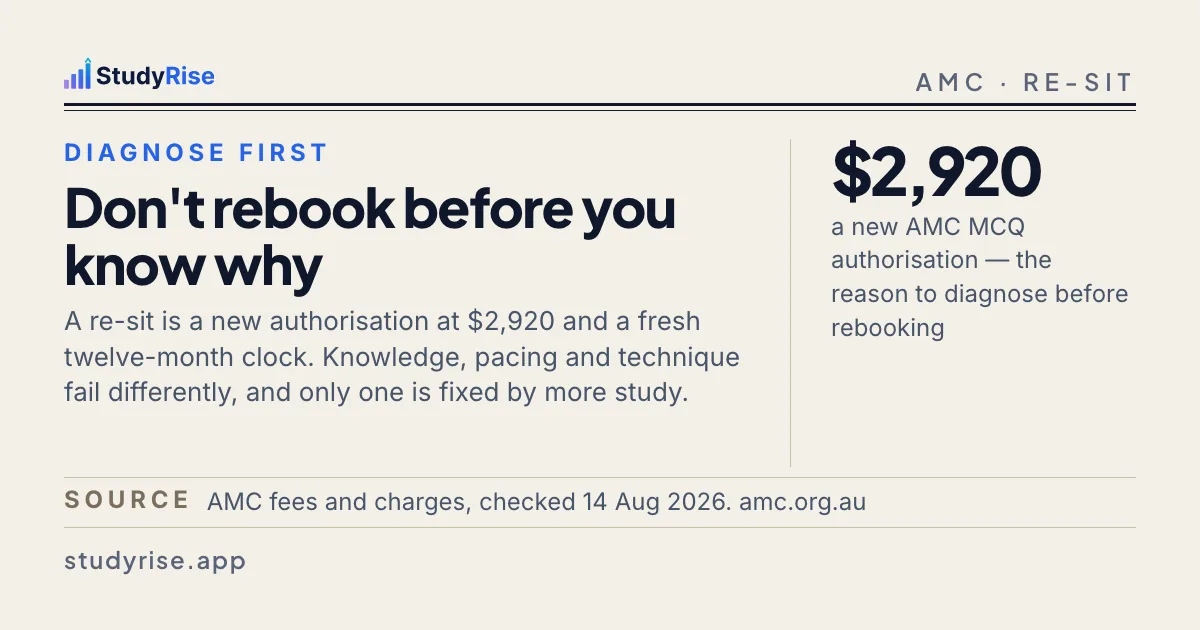
If you have just opened your result and it is a fail, start with twenty minutes and your score report, before you go anywhere near another authorisation. Answer one question honestly: was this knowledge, timing, or technique? Those three failures need different fixes, and paying $2,920 before you know which one you had is how candidates end up failing twice for the same reason.
First, the number that matters
The last figures the AMC published showed 51% of MCQ sittings passed. Its most recent annual report contains no pass rates at all, so that figure is where the published record stops, and we set out its provenance in our guide to the AMC pass rate.
Roughly half. That is the base rate you were sitting against, and it matters because the first story you tell yourself after a fail is that you are uniquely unsuited to this. The number says something plainer: this is a hard examination, and roughly half of the sittings behind that figure ended the way yours did.
What a re-sit actually costs
A re-sit requires a new CAT MCQ examination authorisation at A$2,920, free of GST, plus the AMC's 0.96% card surcharge. Your portfolio is already established, so that fee does not repeat.
- An authorisation buys twelve months, not a seat. It is valid for twelve months in which to schedule a sitting, and the AMC does not publish which date starts that clock, so read the dates on your own authorisation.
- Non-attendance consumes it entirely. If you are authorised for a sitting and do not attend, there is no refund and the authorisation is gone. Cancelling with supporting evidence returns 75% within one month of payment and 50% after that.
So the sequence that protects your money is: diagnose, prepare, then buy. Buying first to create motivation spends the twelve-month window during the period when you are least ready to use it. Our guide to what the AMC pathway costs lays out every fee and refund cliff.
Read the score report properly
Performance is reported on a scale of 0 to 500, with the pass mark described as 250. Your report gives you a total and an indication of performance across content areas.
The shape of that report matters more than the total. A candidate at 240 with one collapsed content area has a different problem from a candidate at 240 who is uniformly a little short, and they need different second attempts. The first needs a targeted block on one area. The second needs broader consolidation and probably more weeks.
Note also that from 2026 the AMC introduced a slightly higher cut score on the same 0 to 500 scale. If you are comparing your result against advice written before that change, the comparison is not exact. We cover what moved in our guide to the 2026 pass-standard change.
Diagnose the actual cause
Be specific with yourself here, because each cause has a different remedy and only one of them is fixed by more study.
| If this was true | The cause | What attempt two needs |
|---|---|---|
| Whole topics were unfamiliar | Coverage | More weeks, blueprint-weighted |
| You knew it but ran out of time | Pacing | Timed blocks at exam speed |
| You changed correct answers | Technique and nerves | Full mocks under real conditions |
| Australian management surprised you | Context | Time in the Australian guidelines |
| You had prepared under six weeks | Time | A real timeline before rebooking |
The pacing row is the one most often misdiagnosed as knowledge. In the exam you have roughly 84 seconds a question, and candidates who know the material but have never practised at that speed read too carefully early and run out of time late. That is a training problem with a specific fix, and studying more content does not touch it. Our guide to daily question volume covers how to build that speed.
How soon to re-sit
Not immediately, and not in a year. Immediately repeats the attempt with the same preparation; a long gap lets hard-won knowledge decay and usually means starting again.
Three to five months is the window we would aim for: long enough for a real block of targeted work, short enough that what you already know is still there. If your diagnosis was pacing or technique, aim at the shorter end, because those failures respond to practice under time and you can put that in place quickly.
Set the date first, then buy the authorisation when your preparation is far enough along that twelve months is comfortable. That ordering is the same one we recommend for a first attempt in our guide to choosing your AMC exam date.
Make the second attempt different from the first
Repeating the same preparation and expecting a different result is the most common pattern in second failures. Change something structural.
- Lead with questions. If your first attempt was reading-led, invert it. Questions expose gaps that reading conceals.
- Keep an error log by cause. Sort every wrong answer into knowledge gap, misread question, or rushed. The mix tells you what to fix.
- Sit full timed mocks earlier than last time. If you left mocks to the final fortnight, move them forward. They are diagnostic, and a diagnosis in the last week is too late to act on.
- Weight your weeks by the blueprint. Medicine and surgery are half the examination between them, so they deserve about half your time regardless of which topics you enjoy.
A fail is expensive, and it earns its cost only if it changes something. Take the diagnosis seriously, give the second attempt a real timeline, and buy the authorisation last.
Sources checked
The authorisation fee, refund structure and card surcharge were read on 14 August 2026 from the AMC's fees and charges page. The 0 to 500 reporting scale, the pass mark of 250 and the 2026 cut-score change come from the AMC's MCQ examination page, which also states that an authorisation is valid for twelve months in which to schedule a sitting. The 30%/20% blueprint weighting comes from the AMC MCQ Examination Specifications, set out in our AMC MCQ syllabus guide. Pass rates are the AMC's last published figures, sourced in our AMC pass rate guide. The three-to-five-month re-sit window and the diagnostic table are StudyRise editorial recommendations; the AMC's MCQ examination page publishes no required waiting period between attempts.