The plan that fails is the one built from a good week. You sketch twenty hours during a quiet fortnight, work returns to normal, you hit eleven, and by week four the plan has turned into a source of guilt. So build it from the bad week and let the good weeks be a bonus.
Start from your worst week, not your best
Write down what you actually achieved in your worst week of the last month. That number, or slightly below it, is your planning baseline.
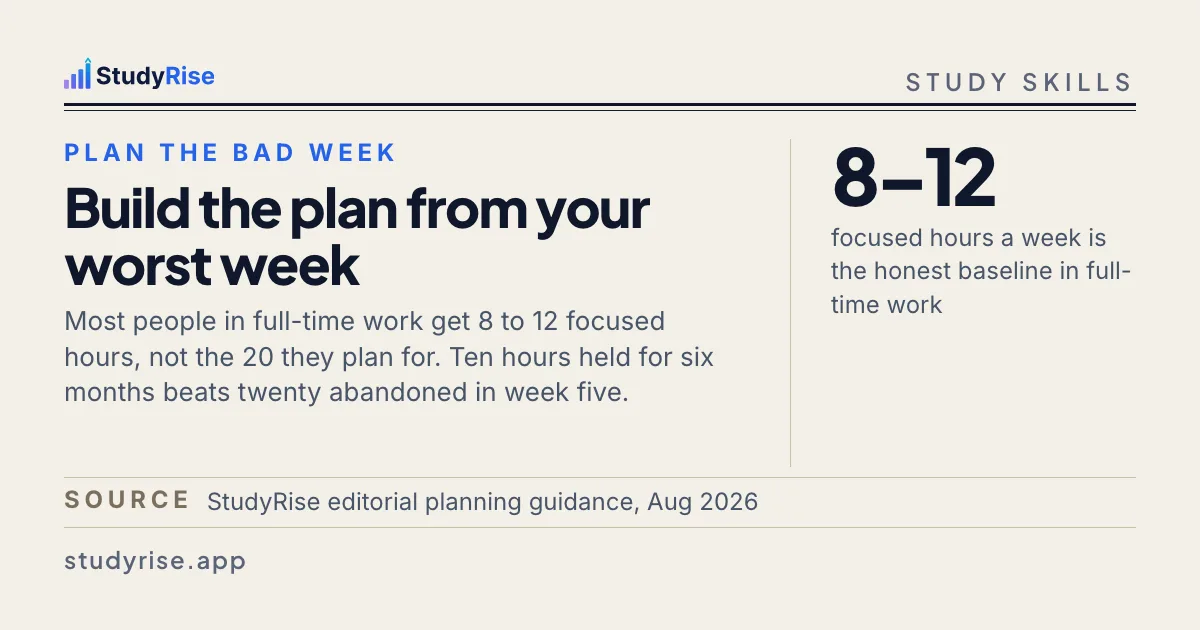
For most people in full-time work the honest figure is 8 to 12 focused hours a week. It looks small next to the totals people quote online, and it is enough: a 10-hour week sustained for six months is 260 hours, which is a serious preparation. A 20-hour plan abandoned in week five is 80.
If you are preparing for a professional examination with published guidance, compare the two openly. Our AMC study plan attaches roughly 18 to 25 focused hours a week to a four-month timeline and 12 to 18 hours to a six-month one, and it puts anything under 12 hours in a third row: use a later date. A baseline of 10 lands you in that third row, so the arithmetic points past six months. Choosing the longer date is a planning decision. Treat it as one.
Fix the slots. Do not look for time
"Finding time" fails because the decision gets re-made daily and loses to fatigue. Fixed slots survive because there is nothing to decide.
Choose three to five recurring blocks and put them in the same calendar you use for work. Then apply two rules:
- Make the weekday block short and specific. Sixty to ninety minutes, with the task decided the night before. A block whose content you have to choose while tired will be spent choosing.
- Put your one long block on the day you are least likely to be called on. For most people that is a weekend morning. Protect it the way you would a shift, including from other people's plans.
Prepare the first ten minutes in advance. Leave the book open, the question set loaded, the tab already there. After a working day the hard part is starting; concentration turns up once you have begun.
If you work shifts
Shift work breaks fixed weekly slots. Anchor to the roster: a weekly calendar will not survive your shift pattern. Build a small repeating template tied to it, with a set block on a post-night rest day, a set block on the second day off, and nothing at all on the day after a run of nights.
Scheduling study straight after night shifts is the most common self-inflicted injury here. Retention is poor, the hour is miserable, and it builds an association between studying and exhaustion that costs more than the hour gained. Sleep, then study on the following day.
Where your roster is published in advance, plan the whole fortnight the day it appears. Twenty minutes with the roster and a calendar buys back several hours of drift.
What to do in a short block
Short blocks reward retrieval and punish reading. Ninety minutes of re-reading notes produces very little; ninety minutes of answering questions and reviewing the errors produces a lot.
So default to practice questions, past papers or self-testing, and use reading only to close a gap that a question just exposed. That order matters more when time is scarce than when it is plentiful, because retrieval also tells you what to do next, and a tired person needs the decision made for them.
Keep a running error log. It converts scattered short sessions into something cumulative, and it hands your weekend block a ready-made list to open with. Our guide to spaced repetition covers how to schedule the reviews those errors generate.
When a week collapses
Some weeks you will do nothing. A project goes wrong, a child is ill, you cover someone else's shifts. This is normal and the plan must survive it.
Do not attempt to repay the debt. Trying to add a lost eight hours onto the next week produces a second failed week and a worse mood. Instead:
- Write off the week deliberately. Record it in the plan, so it reads as a decision you made.
- Resume at your normal load.
- If three weeks go in a quarter, move the exam date and leave the plan alone.
That third rule is the one people resist and the one that works. A date moved once, early, costs far less than a date kept and failed.
Choosing a date you can reach
Multiply your honest weekly hours by the weeks available, then compare that total against what your exam realistically needs. If the gap is large, move the date. Raising the intensity is what fails in week five.
Where an examination authorisation runs on its own clock, check what you are committing to before you pay. The AMC's MCQ authorisation is valid for twelve months to schedule one examination event, and the AMC does not publish which date starts that clock, so take it from your authorisation letter. Cancel with supporting evidence and the refund is 75% within one month of payment and 50% after that, up to the end of the authorisation; miss the sitting and the authorisation is consumed with no refund at all. Our guide to choosing your exam date sets out how to time that.
If you are reading this at eleven at night after a long shift, wondering whether ten hours a week is enough: it is, if you get most of them, most weeks, for long enough. That is the whole method.
How we checked
The weekly-hours guidance for the AMC MCQ is StudyRise's own published recommendation in our AMC study plan. The twelve-month authorisation term is the AMC's own wording on its MCQ examination page, checked 14 August 2026; the refund tiers are from the AMC's fees and charges page, checked the same day. The 8-to-12-hour baseline is an editorial planning heuristic offered as a starting point for your own measured figure, and no research finding sits behind it. The advice on retrieval practice over re-reading is consistent with the spacing and testing literature cited in our spaced repetition guide.