Most people trying to build a study routine start in the wrong place: a blank weekly grid and a Sunday evening. They fill it with the hours they wish they'd do, feel briefly organised, and abandon it somewhere around the second Wednesday.
The failure is rarely laziness. It is that the routine was designed as a schedule when what it needed to be was a set of habits, and habits are built from repetition in a stable context rather than from ambition.
This guide takes the other route. It starts from the parts of your week that are already fixed, hangs study sessions off them, keeps the first version deliberately small, and then leaves it alone long enough to become automatic. Along the way it puts a number on how long "long enough" is, because the number in circulation is wrong and believing it is one of the more common reasons people quit two-thirds of the way to a working routine.
A routine is not the same thing as a study plan
These get used interchangeably and they are different objects. A study plan is content: the list of topics, the order, the deadlines, how much time each thing deserves. A routine is structure: the recurring slots that plan gets poured into.
You need both, and they fail differently. A plan without a routine turns into a list you keep meaning to start. A routine without a plan turns into an hour a day of doing whatever is nearest to hand, which feels productive and quietly leaves your hardest module untouched until week nine.
The practical division is that the plan changes as the term goes on and the routine mostly shouldn't. If you already know what you need to cover, our guide to making a study plan you'll actually stick to handles the content side, and this page handles the slots. If you're planning around fixed exam dates rather than a whole term, a revision timetable is the tighter, dated version of the same idea.
How long a study routine takes to stick
You have probably heard that a habit takes 21 days. That number comes from Psycho-Cybernetics, a 1960 self-help book by the plastic surgeon Maxwell Maltz, who observed that his patients took about three weeks to get used to seeing a new face in the mirror. It was an aside about adjustment after surgery. Maltz never studied habit formation, yet the line has been repeated so often since that it now reads as established fact.
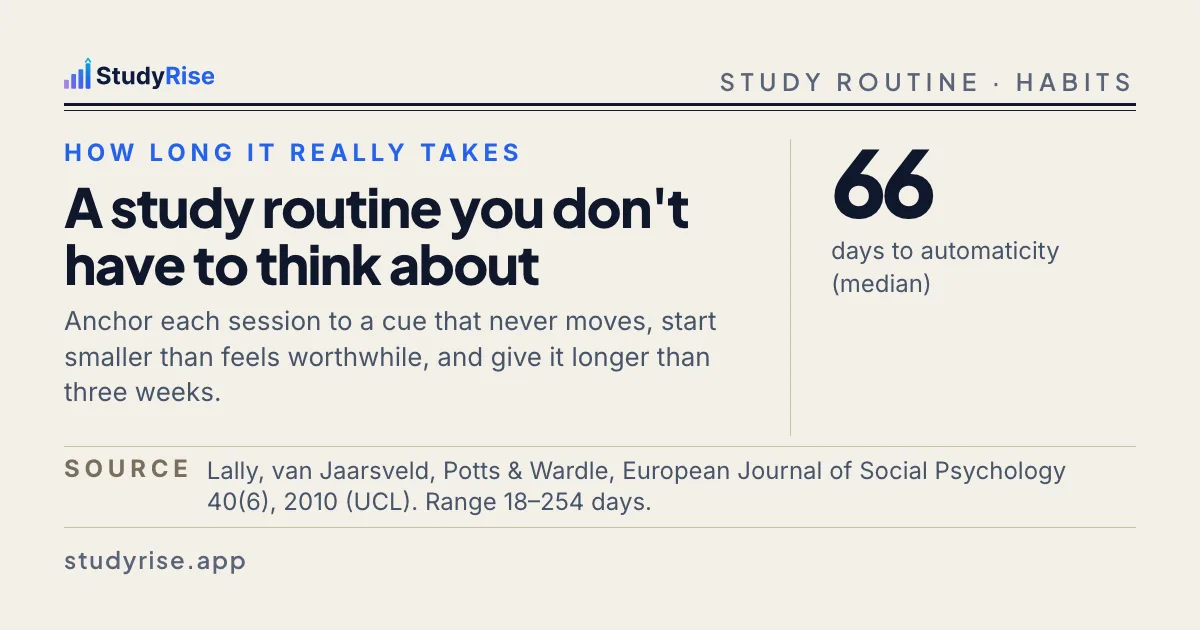
The research that did look at this properly tells a different story. A University College London team followed 96 volunteers who each chose one eating, drinking or activity behaviour to perform daily in a consistent context for 12 weeks, rating how automatic it felt each day.
The median time to reach the plateau where the behaviour felt automatic was 66 days, measured across the participants whose data fitted the model curve rather than all 96, and the spread across those individuals ran from 18 days to 254 (Lally, van Jaarsveld, Potts & Wardle, European Journal of Social Psychology, 2010).
Two things follow from that, and both are more encouraging than they sound. First, a routine that still requires effort in week four is not broken; it is normal, and about a third of the way there. Second, the variation is enormous, so comparing your fourth week to someone else's account of theirs tells you almost nothing. The honest expectation to set is a couple of months of deliberate effort before the sessions start happening without a decision behind them.
Anchor each session to a cue that doesn't move
The UCL participants attached their new behaviour to an existing daily event, and that detail is doing more work than it looks like. A cue that is already reliable carries the new behaviour with it. A cue you invented has to be remembered, and remembering is exactly what runs out on a tired Thursday.
So build your routine off the fixed furniture of your week. "After my Tuesday seminar, before I leave the building" is a strong anchor: the seminar happens regardless of how you feel, you are already in a place suited to work, and there is no journey in between to lose you. "7pm on weekdays" is a weak one, because nothing in your day announces it.
The strongest anchors tend to be the end of a class, arriving somewhere with a desk, or the gap either side of a meal you eat at roughly the same time.
Two or three anchored sessions is a routine. Seven is a wish. Pick the slots that recur every single week and leave the rest of your studying unscheduled at first, because the point of this stage is building reliability. Coverage comes back once the sessions are running on their own.
Start smaller than feels worthwhile
The instinct when building a routine is to make each session substantial enough to justify the effort of showing up. That instinct is backwards. In the first month the goal is making the session happen reliably enough that it becomes automatic; efficient coverage comes later. A 30-minute block you complete every Tuesday and Thursday for six weeks is worth more than a three-hour block you manage twice and then start dreading.
The honest pattern is that most study routines fail from being too ambitious on day one, and discipline rarely has much to do with it. A session small enough to feel almost trivial removes the negotiation. You cannot reasonably tell yourself you are too tired for 25 minutes, and once you are sitting down with the material open you will often keep going anyway. Grow the blocks only after the habit is holding.
What goes into the week
Once the slots exist, decide what fills them. A routine that only books new learning has the same flaw as a revision timetable that only books first passes: everything gets covered once and then quietly leaks away. A week that holds up has four kinds of block in it.
New material is the obvious one, and usually the smallest share of a good week after the first few weeks of term. Review is the block people skip, and it is the one that decides whether any of the new material is still there in June.
Spacing those reviews at widening gaps is the most reliably supported finding in the study-methods literature, and our guide to spaced repetition for exams covers how to place the intervals. Practice means questions, past papers and problems attempted before you feel ready, because retrieval under mild difficulty is what makes material usable rather than familiar. And slack deserves a scheduled block of its own.
The mix shifts across a term. Early on it is mostly new material with light review; by the run-up to exams it inverts, and the routine becomes largely practice and review. The slots stay where they are; what happens inside them changes. That stability is the whole advantage of separating routine from plan. If you're mapping a full term's worth of assessments underneath all this, planning a university semester works through the weighting side.
A worked example: one routine week
Here is a routine for a student with lectures Monday to Thursday and a weekend shift. Yours will look nothing like it, and that is fine. What to notice is the shape: every session hangs off a fixed event, review appears more often than new material, one session is explicitly droppable, and Sunday is left alone.
| Day | Anchor | What happens in the block |
|---|---|---|
| Mon | After the 11am lecture, same building | 45 min: notes from that lecture into questions, while it's fresh |
| Tue | After dinner, at the desk | 45 min: new topic, first pass |
| Wed | After the 11am lecture, same building | 45 min: review last week's material by testing yourself |
| Thu | After dinner, at the desk | 45 min: practice questions on the hardest current topic |
| Fri | Optional, if the week went well | The droppable session. Missing it costs nothing |
| Sat | Before the shift | 60 min: catch-up slot, or a longer mixed practice set |
| Sun | — | Nothing scheduled. Deliberately |
The shape of one session
Inside a block, the useful structure is work in a defined stretch, then a real break. Giving a session an end time matters more than the specific length, because an open-ended obligation is what your brain resists at the start and drifts through in the middle. The Pomodoro technique is the best-known version of this, and its 25-minutes-on, 5-minutes-off split is a perfectly good default for a first attempt.
It is a default, and treating it as a hard rule is a mild trap. Breaking off a hard problem at 25 minutes because a timer said so, right when you were finally getting somewhere, is worse than finishing the thought. Longer blocks suit reading and problem sets; shorter ones suit memorisation and anything you're avoiding.
Take the block-and-break principle, drop the arithmetic, and let the length follow the work. The wider set of techniques that belong inside a block is covered in our guide to study tips that work.
When you miss a session, and you will
Every routine gets broken. The variable that matters is not whether you miss a session but what you do at the next cue. Missing one session has close to no effect on a habit that is forming. Deciding the week is ruined, skipping the next four, and then feeling too far behind to restart is what ends routines, and it is a much more common failure than the original missed session.
Two design choices make this easier. Keep one session in the week that is explicitly allowed to disappear, so a bad Tuesday has somewhere to be absorbed rather than becoming evidence that the plan failed. And keep a catch-up block that is not pre-assigned, so falling behind has a destination. If you've slipped further than a single week, our guide to catching up when you're behind covers triaging by weight and deadline instead of trying to redo everything.
Resist the urge to repay missed hours with interest. Doubling a session to make up for a skipped one turns the routine into a punishment, and a routine you associate with punishment is one you will find reasons to avoid. Restart at the next anchor at the normal size.
Keeping the routine going without holding it in your head
The hard part of a study routine after the first month is remembering what each session was supposed to contain: which topic is due for its second review, what you flagged as weak a fortnight ago, which practice set you never marked. That bookkeeping is what quietly degrades a routine into an hour of doing whatever is nearest.
StudyRise's study planner handles that half. It turns your syllabus into a daily plan, schedules the spaced reviews for you, and moves them when a week runs over, so the session you show up to already knows what it is for.
The routine still has to be yours: the anchors, the sizes, the day off. What a tool removes is the reason routines decay, which is the daily effort of deciding what to do with the block you just showed up to.