Passing the MCQ moves you to a choice, not to a finish line. You either sit the AMC Clinical Examination or you complete a workplace based assessment, and the two differ enough in cost, timing and risk that picking by default is expensive. One of them requires a job you may not have yet. The other has historically ended without a pass in about three sittings out of four — a rate per examination sat, not per candidate, because someone who sits twice appears twice in it.
The decision in one table
| Clinical Examination | Workplace based assessment | |
|---|---|---|
| AMC fee | $3,000 in person, $3,400 online | $1,070, plus the provider's own programme fee |
| You need | A passed MCQ | A passed MCQ, current registration, and an appointment at an accredited hospital or general practice |
| Shape | One examination day, 20 stations | Assessment spread across months of real clinical work |
| Assessed by | Examiners at scored stations | Supervisors, using case discussions, observed encounters and colleague feedback |
| Main risk | A single bad day ends the attempt | Getting a place at all |
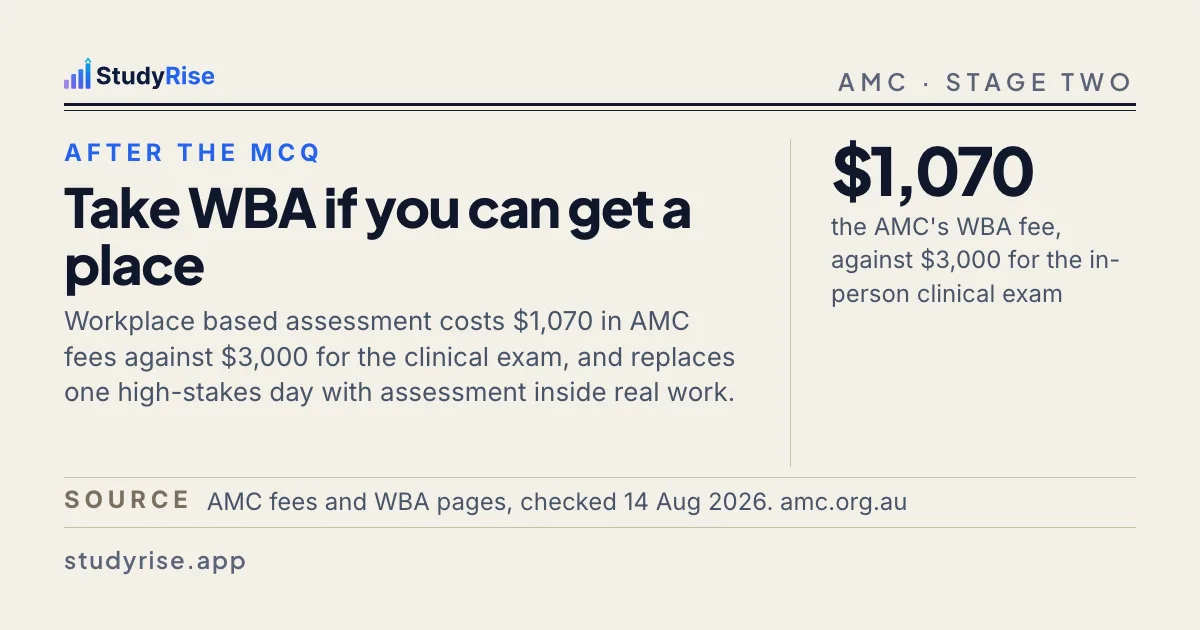
Take WBA if you can get a place. It costs less in AMC fees, it replaces one high-stakes day with assessment inside work you are doing anyway, and it produces a supervisor who has watched you practise. The reason more candidates do not take it is availability rather than merit: you need registration and an appointment at an accredited provider, and those are not on tap the moment you pass the MCQ.
Take the clinical examination when you cannot get a WBA place, or when you would rather not wait for one. It is the route open to you regardless of employment, which is exactly why most candidates end up on it.
What the clinical examination actually is
Twenty stations. Sixteen are assessed and four are rest stations. Each runs ten minutes: two minutes of reading time, then eight minutes of assessment.
Here is the detail worth building your preparation around. Of the sixteen assessed stations, fourteen are scored, and you pass by achieving a pass score in nine or more of those fourteen. There is no aggregate mark to rescue a weak station with a strong one. It is a count.
That count changes what practice should look like. Nine of fourteen means you can lose five scored stations and still pass, so a single disaster is survivable and a pattern of near-misses is not. Practise to make every station competent rather than to make three of them excellent.
Stations cover clinical presentations across medicine, surgery, women's health, paediatrics and mental health, in both community and hospital settings. Each one focuses on one of four tasks:
- history taking
- examination
- diagnostic formulation
- management, counselling or education
Rehearse the four tasks as four separate skills. Candidates who have been out of exams for years usually have the knowledge and lose stations on task discipline: giving management when the station asked for a diagnosis, or taking a history when the examiner asked for an examination. Read the stem in your two minutes and name the task to yourself before you open the door.
If you sit it online, the equipment is a hard requirement
The online clinical examination carries a $400 levy on top of the $3,000, and it carries a specification. The AMC requires a desktop or laptop running Windows 11, a screen of at least 14 inches, and plug-in headphones with a microphone.
Read that as a shopping list rather than a suggestion. A Mac does not meet it. A tablet does not meet it. Wireless earbuds do not meet it. The refund rules make the stakes explicit: if the examination fails because of a technical problem at your end you get nothing back, while an outage genuinely beyond anyone's control returns half. Borrow a compliant machine and test it well before the day, because that distinction is worth $3,400.
If your home connection is at all unreliable, sit it in person. The travel is usually cheaper than the risk.
What a workplace based assessment involves
WBA assesses you where you already work, using the AMC's three assessment methods:
- Case-based discussion. You talk through the reasoning behind cases you managed.
- Mini-clinical evaluation exercise. A supervisor observes you with a real patient.
- Multi-source feedback. Colleagues around you contribute a view.
The national assessment forms are the standardised record that ties the three together; they are the paperwork, not a fourth assessment.
The eligibility bar is the honest catch. You need to have passed the CAT MCQ, hold current registration as a medical practitioner, and hold an appointment at a hospital or general practice position with an accredited provider. If you are outside Australia and not yet registered, WBA is not available to you today, whatever its merits.
Ask the provider for its programme fee in writing before you accept a place. The $1,070 is the AMC's charge; the provider sets its own, and it is often the bigger number. Accepting a place also starts the AMC's refund clock, which drops to 50% immediately and to nothing once the programme begins.
Why the second stage deserves more respect than the first
The last figures the AMC published showed 51% of MCQ sittings passed and 24% of clinical examinations passed. Its most recent annual report contains no pass rates at all, so these remain the most recent published figures rather than current ones, and we set out their provenance in our guide to the AMC pass rate.
Candidates routinely treat the MCQ as the mountain and the clinical examination as the formality that follows. On the last published evidence it is the other way round. Plan the second stage as its own project with its own months, not as a victory lap after the first.
Results arrive at a fixed time
For both the MCQ and the clinical examination, results are available to download from your AMC account at 4.00pm on the Friday three weeks after your examination. Knowing that in advance is worth something practical: do not book leave, interviews or a re-sit decision around a guess, and do not refresh the portal in week two.
Sources checked
Station counts, timings, the nine-of-fourteen pass rule, content areas and the online equipment specification were read on 14 August 2026 from the AMC's clinical examination page. WBA components and eligibility come from the AMC's workplace based assessment page, and fees and refund rules from its fees and charges page. Pass rates are the AMC's last published figures, sourced in our AMC pass rate guide. The preparation advice and the recommendation to prefer WBA where available are StudyRise editorial judgement.