You sit down at seven with three chapters to get through. At seven-forty you have read the same page twice, replied to two messages, checked one thing that couldn't wait, and opened a tab about something unrelated. The evening isn't wasted exactly, but you've been at the desk for forty minutes and covered about six minutes of material. Nobody in that situation lacks discipline. The session was built in a way that made drifting the easiest available option.
This guide is about changing that setup. It goes through why attention leaves in the first place, what to remove before you start, how to give a session a shape, and what to do in the moment you catch yourself somewhere else. It's aimed at university and college study, though the same moves work for exam revision. What it won't tell you is to want it more.
Why your attention keeps leaving
Every time you switch away from what you're studying, some part of your mind stays behind on it, and some part of the thing you switched to comes back with you.
Sophie Leroy's research on attention residue (Leroy, 2009) describes this: after an interruption, especially an unresolved one, performance on the next task suffers because attention hasn't fully arrived yet. The practical version is familiar to anyone who has answered one message mid-chapter and then read three paragraphs without absorbing them.
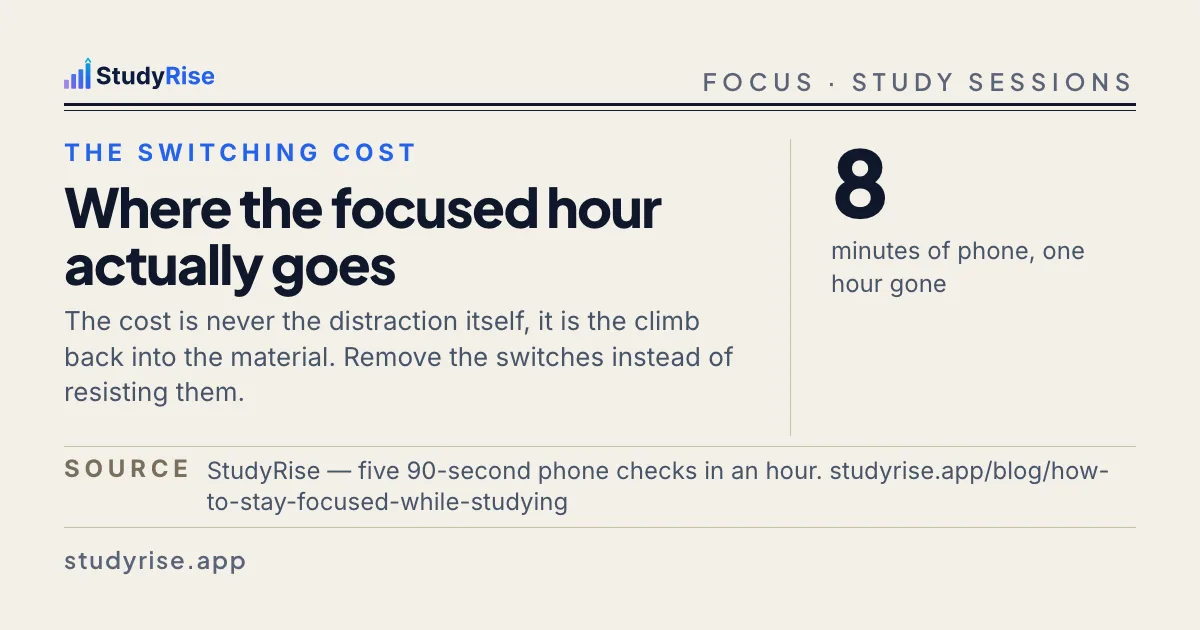
That's why the real cost of a distraction is almost never the distraction itself. Ninety seconds on your phone costs ninety seconds plus the climb back into the material, and the climb is the expensive part.
Five of those in an hour and the hour is gone, even though the interruptions themselves only add up to about eight minutes. That arithmetic is an illustration rather than a measured finding — Leroy's work measures the residue left behind by switching, not a fixed multiplier on lost time. It is still why "just concentrate harder" is such poor advice. It asks you to pay the switching cost repeatedly instead of removing the switches.
Fix the setup, not the willpower
Start with the phone, because it's the most reliable interruption source most students have. Face-down on the desk isn't enough: it's still within arm's reach, so every few minutes you spend a little attention deciding not to pick it up. Put it in another room, in a bag across the room, or in a drawer. The point is to make checking it require standing up and a conscious decision rather than a reflex.
Worth being honest about the evidence here, since a lot of study advice overstates it. Ward and colleagues (2017) found that the mere presence of your own phone reduced available cognitive capacity even when people didn't touch it — and a 2022 replication failed to reproduce that effect.
So treat "the phone drains you just by sitting there" as unsettled. What isn't in dispute is much simpler: the phone is where the interruptions come from, and interruptions are costly. That alone justifies putting it out of reach.
Then do the same to everything else. Close the tabs the task doesn't need, silence notifications on the laptop as well as the phone, and clear the desk of anything unrelated. If you study with music, instrumental tends to compete less with reading than lyrics do, but the honest answer is that this varies enough between people that you should test it on yourself rather than trust a blog. Silence is the safest default for dense material.
Decide the task before you sit down
A surprising amount of study time disappears in the first ten minutes, in the negotiation about what to start with. If the session opens with "right, what should I do", you've handed your freshest attention to a decision rather than to the work. Decide it in advance, the night before or at the end of the previous session, and write it down as something specific enough to finish: "twelve practice questions on renal physiology", not "do some physiology".
Specificity does two jobs. It removes the opening decision, and it gives the session a finish line, which makes it far easier to start something you're dreading.
If you don't have a list of tasks that granular, the problem is upstream of focus and it's worth fixing there first — our guide to making a study plan you'll stick to covers breaking a syllabus into session-sized pieces, and if you're timetabling toward exams, building a revision timetable does the same across weeks.
Give the session a shape and an end
An open-ended study session has nothing in it to defend. "I'll study this afternoon" can absorb any amount of drifting without ever feeling like it's failing. A block with a start and an end is a different object: there's a fixed amount of it, so spending some on your phone is visibly spending something.
Most students land somewhere between 25 and 90 minutes per block, with a real break after. Shorter blocks are better for material you're avoiding, because starting is the hard part and a 25-minute commitment is easy to agree to. Longer blocks suit essays and problem sets that need a warm-up.
The Pomodoro technique is the popular version of this, and it works — though not because 25 minutes is magic. What it gives you is a visible end point and a sanctioned break, which is what makes it acceptable to ignore everything else until the timer goes. Adjust the intervals to the work rather than treating them as a rule.
| What's happening | The usual advice | What to do instead |
|---|---|---|
| Checking your phone every few minutes | Put it face-down | Put it in another room, so checking costs a decision |
| Reading without absorbing | Re-read the section | Close the book and write down what you remember |
| Ten minutes lost deciding what to do | Make a to-do list | Decide the specific task before the session starts |
| Drifting after 20 minutes | Push through it | Shorter blocks with a real break, not a longer slab |
| Studying somewhere you also relax | Try harder | One surface, one job — or leave the house |
Make the work hard enough to hold you
Some study formats are almost designed for drifting. Rereading notes and highlighting both feel productive and demand very little, so your attention has room to wander while your eyes keep moving. You can be forty minutes into a chapter before noticing that nothing has gone in.
Active work doesn't leave that room. Close the book and write what you remember, answer practice questions, explain a concept out loud as if teaching it, work problems without looking at the solution first. This keeps asking you for something, so drifting gets caught within seconds rather than pages. It's also, separately, the more effective way to learn — which makes it the rare fix that improves focus and retention at once.
Our guide to study tips that work goes through the evidence for active recall, and spaced repetition for exams covers how to schedule those self-tests so earlier material keeps getting revisited.
When you notice you've drifted
You will drift. The useful skill isn't preventing it, it's shortening the round trip back. Two habits do most of the work.
First, keep a scrap of paper or a single note for everything that surfaces mid-session: the thing you must remember to email, the question you want to look up, the sudden urge to check a date. Write it down and carry on. Most intrusive thoughts are just fear of forgetting, and parking them settles that without opening a browser.
Second, skip the self-recrimination. Noticing you've been elsewhere for five minutes and then spending another five annoyed about it doubles the cost of the lapse. Note where you were in the material, take the next sentence, and continue. Students who study consistently aren't the ones who never lose focus. They're the ones who get back faster and don't treat a bad twenty minutes as evidence the session is ruined.
Studying at home, where everything competes
Home is hard because the space is ambiguous. The table where you study is also where you eat and scroll, so sitting down there doesn't signal anything to you. Give one surface one job: study at the same desk every time, keep unrelated things off it, and do your relaxing somewhere else. It sounds fussy and it works, because you stop having to decide what mode you're in.
A repeated start ritual helps for the same reason — same drink, same clear desk, phone parked, task already written down. Do it in the same order every time and it becomes the cue that a session is starting, rather than something you talk yourself into.
And if home keeps losing, leave. A library or campus study space works partly because everyone around you is visibly working and there's nothing else there to do, which is environmental design you don't have to build yourself.
When it isn't a focus problem
Sometimes the setup is fine and attention still won't hold. Before adding more techniques, check the obvious upstream causes. Short sleep degrades sustained attention more than most students want to admit, and no study environment compensates for it.
Doing too much at once has a similar effect: if you're carrying five deadlines with no plan, the anxiety about everything you aren't doing will follow you into every session. That's a planning problem wearing a focus costume, and catching up when you've fallen behind deals with it by triaging rather than by concentrating harder.
There's also a line worth naming. If difficulty focusing has been constant for years, across every setting, and it affects more than studying, that's worth raising with a doctor or your university's student support or disability service. Study technique isn't a substitute for an assessment, and a guide like this one shouldn't pretend otherwise.
Keep the decisions out of the session
Most of what's above comes down to one idea: decide things before the session so the session itself has nothing to negotiate. That's the part a planner can carry for you. StudyRise's study planner turns your syllabus into a daily plan, so when you sit down the next task is already chosen, along with a built-in Pomodoro timer for the block and the spaced reviews scheduled into the same list you're already checking.
It won't make you sit down, and no app will. What it removes is the gap between sitting down and starting — the one where you open a browser to "just check what's due" and lose the first fifteen minutes. If your terms and deadlines are the messier problem underneath, planning a university semester is the better place to start, and the focused sessions get easier once the plan above them is settled.