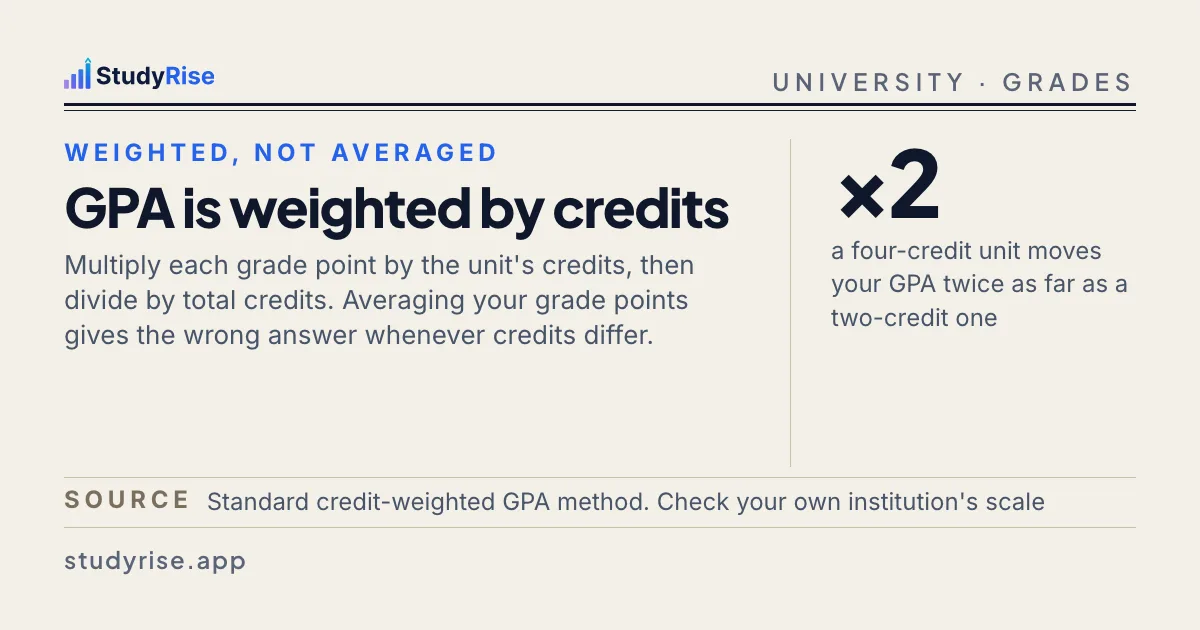
Most GPA confusion comes from one wrong assumption: that GPA is the average of your grades. It is the average of your grades weighted by credit, and the difference is large enough to change a decision about which unit to prioritise in the last fortnight of a semester.
The formula
- Convert each unit's grade to its grade point, using your institution's scale.
- Multiply each grade point by that unit's credit value. This gives the unit's quality points.
- Add the quality points and divide by the total credits attempted.
Written out: GPA = total quality points ÷ total credits.
A worked example
Four units on a 4.0 scale, with different credit values.
| Unit | Grade point | Credits | Quality points |
|---|---|---|---|
| Anatomy | 3.0 | 4 | 12.0 |
| Statistics | 4.0 | 3 | 12.0 |
| Ethics | 2.0 | 2 | 4.0 |
| Research methods | 3.0 | 3 | 9.0 |
| Total | 12 | 37.0 |
37.0 ÷ 12 = 3.08.
Now average the four grade points on their own: (3.0 + 4.0 + 2.0 + 3.0) ÷ 4 = 3.00. Close, and wrong. The gap grows as your credit values diverge.
The mistake almost everyone makes
Averaging grade points directly treats a two-credit elective as equal in weight to a four-credit core unit. It is not, and your institution's calculation knows it.
This matters most when you are deciding where to spend a limited last fortnight. If you can lift one unit by a full grade point, lift the one with the most credits. In the example above, moving Anatomy from 3.0 to 4.0 adds four quality points and takes the GPA to 3.42. Moving Ethics from 2.0 to 3.0 adds two and reaches 3.25. Same effort, different result, and the credit column is what tells you which is which.
Grade scales are not universal
The 4.0 scale is common but far from standard. Some institutions use a 7.0 scale, some report a weighted average mark out of 100 instead of a GPA, and plus and minus grades may or may not carry distinct points.
Find your institution's official grade-point table before you calculate anything. Two details change the answer and are easy to miss: whether a failed unit contributes zero quality points while still counting in your total credits, which it usually does, and whether a repeated unit replaces the original grade or sits alongside it. Both are institution-specific rules with real consequences.
Semester GPA and cumulative GPA are different numbers
Your semester GPA covers one semester's units. Your cumulative GPA covers everything you have attempted, and it moves more slowly as your total credits grow.
This is worth understanding early rather than late. In first year, one semester is a large share of your total credits and a poor result moves the cumulative figure sharply. By final year the same semester barely shifts it. The corollary is uncomfortable and useful: early semesters are the cheap ones to protect, and late recoveries are arithmetically hard.
Working out what you need
To find the semester GPA required to reach a target cumulative figure, work in quality points instead of averages.
- Multiply your target cumulative GPA by your projected total credits. That is the quality points you need overall.
- Subtract the quality points you already hold.
- Divide the remainder by the credits still to come.
If the answer exceeds the maximum on your scale, the target is not reachable in that timeframe, and it is better to learn that now than in the final week. Those three steps are hand arithmetic. Our grade target calculator does the neighbouring job in the forward direction: it turns a list of credits and grades into a term GPA and folds that into your prior cumulative figure, so you can try a semester result and see where the cumulative number lands. StudyRise's university mode records each unit's grade against its credits as results come in; the aggregate term GPA and the running multi-term figure are part of StudyRise Pro.
One honest limitation: no calculator knows your institution's rules on failed and repeated units. Check those against your own academic regulations before acting on any projected figure, ours included.
How we checked
The credit-weighted formula described here is the standard method used by institutions that report a grade point average, and the worked examples are arithmetic you can check line by line. Grade scales, the treatment of failed and repeated units, and whether plus and minus grades carry distinct points are all set by your institution and vary between them: your own academic regulations are authoritative. Checked 14 August 2026. The prioritisation advice is StudyRise editorial judgement.