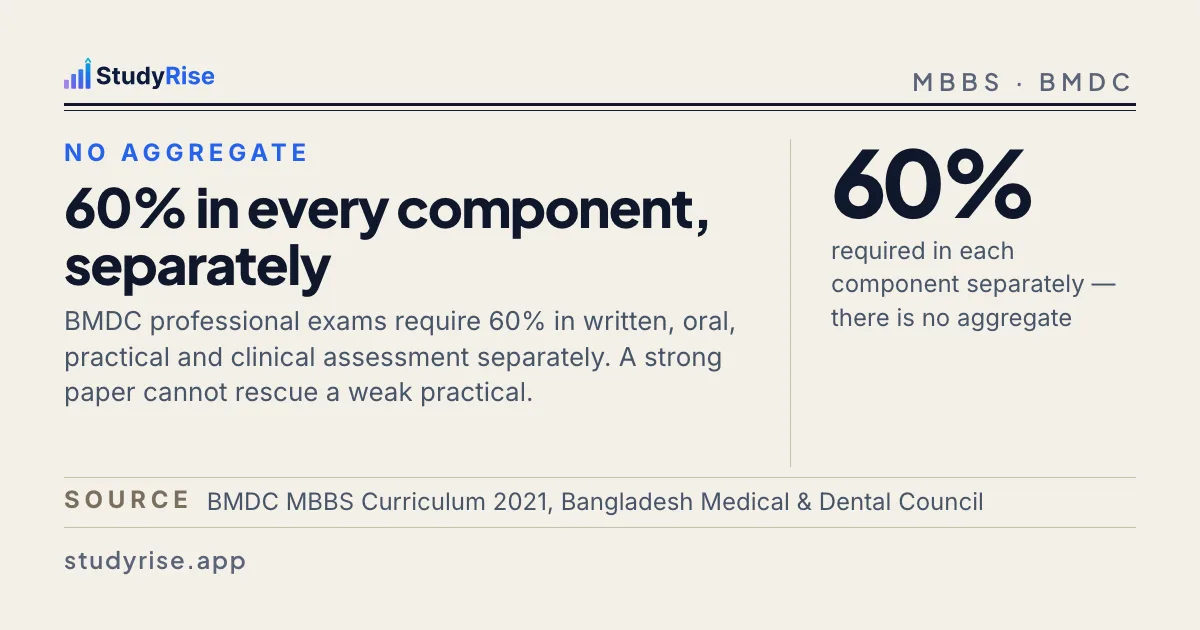
The MBBS course in Bangladesh runs five years, and it is followed by a mandatory logbook-based rotatory internship of one year. Six years from admission to full BMDC registration. The BMDC Curriculum 2021 sets the structure, and the rule that decides most students' results is not the syllabus at all: you must pass every component of a professional examination separately.
Five years, four phases, then a year of internship
The curriculum divides the MBBS course into four professional phases, each ending in a professional examination. The medium of instruction is English throughout.
After the final professional MBBS examination comes the internship: one year, rotatory, and logbook based. It is mandatory. You apply for provisional BMDC registration once you have passed finals — that is what makes the internship legal — and you convert it to full registration, the licence to practise independently, once the year is complete. Our BMDC registration guide walks through both steps. Plan for six years when you are thinking about timelines, family expectations or finances.
The rule that fails more students than any syllabus
You must obtain at least 60% in each component separately. The BMDC MBBS Curriculum 2021 states it plainly: a student has to pass written, oral, practical and clinical examinations separately, and formative assessment carries its own 60% requirement.
Read that twice, because it removes a strategy most students arrive with. There is no aggregate. A brilliant written paper does not carry a weak oral. Scoring 85% in theory and 55% in practical is a fail, and it is a fail you cannot see coming if you have been tracking an average.
So track your components. If you keep one number for a subject, you are measuring something the examination does not use. Keep five.
| Component | Requirement | What it means in practice |
|---|---|---|
| Written | 60% | SBA and MTF-MCQ, SEQ, SAQ |
| Oral | 60% | Cannot be rescued by written marks |
| Practical | 60% | The one most often underprepared |
| Clinical | 60% | Ward work is exam preparation |
| Formative | 60% | Accumulates all year, before finals |
The formative row is the one to act on first, because it is the only one you cannot revise for in the last month. It accumulates across the year through work you either did or did not do at the time.
How the grade scale treats a near miss
The curriculum's grading table is unforgiving at the boundary. Marks from 60% to below 65% earn a B and a grade point of 3.00. Anything below 60% is an F, with a grade point of 0.00.
There is no D and no consolation band. The distance between 59% and 60% is the distance between a zero and a 3.00, in that component, in that examination. That single step is why component-level tracking matters more here than in systems that let a strong paper average out a weak one.
Phase 1 carries 1300 marks, and it arrives first
The first professional examination carries 1300 marks across Anatomy, Physiology and Biochemistry in the Council's own curriculum sections. Only the Final Professional is larger, at 1500 — and Phase 1 is the one you sit before you have worked out how medical school runs. It also covers the basic sciences that everything after it assumes.
Treat Phase 1 as the foundation it is. Those three subjects are not hurdles to clear and forget; the clinical phases are built on them, and a shallow first pass costs you twice.
The twelve-year window
After taking admission into the first year of the MBBS course, a student must complete the whole course and pass the final professional MBBS examination within twelve years.
Twelve years sounds generous against a five-year course, and it is, until illness, a repeated professional examination or a year out compresses it. Know the date your window closes. If you have already repeated a phase, work out exactly how much room is left.
What to do with all this
- Track five numbers per subject, not one. Written, oral, practical, clinical and formative each have their own 60% gate, and an average hides exactly the component that will fail you.
- Protect formative marks from the first week. They accumulate through the year and no revision block recovers them.
- Give practical and clinical real calendar time. They are the components students consistently defer, and they carry the same 60% bar as the written paper.
If you are in first year and this feels like a lot to hold, that is the correct reaction, and it is a tracking problem before it is anything else. StudyRise's MBBS mode is built around the BMDC 2021 structure and keeps the component split visible, which is the part a notebook average quietly loses.
Sources checked
Course duration, the four-phase structure, the mandatory one-year logbook-based rotatory internship, the English medium of instruction, the 60% pass requirement in each component separately, the formative assessment requirement, the grading table and the twelve-year completion window are taken from the BMDC MBBS Curriculum 2021, which the Bangladesh Medical and Dental Council publishes section by section on its own site (checked 14 August 2026). Phase 1's 1300-mark total and the Final Professional's 1500 come from the same document. The provisional-then-full registration sequence is the Council's, and our BMDC registration guide covers it in detail. Verify any figure against the current curriculum before relying on it for a decision, and confirm your own college's assessment arrangements with your institution. Every piece of study advice here is StudyRise editorial judgement; the BMDC does not issue it.