How to Pass the AMC MCQ in 4 Months: A Practical Study Plan for IMGs
Can you really pass the AMC MCQ in 4 months?
Yes, it is possible to prepare for the AMC MCQ in 4 months — but only if your plan is structured, question-heavy, and honest about your weaknesses.
The AMC MCQ is not an exam where passive reading alone works. It tests clinical reasoning, investigation choices, management decisions, Australian guideline familiarity, emergency recognition, ethics, public health, and safe practice. That means your preparation should not just be "finish all subjects." Your real goal should be:
Cover the core subjects, solve enough questions, review your mistakes properly, and repeatedly test whether you are becoming exam-ready.
This article gives you a practical 4-month AMC MCQ preparation plan using resources such as eMedici, the official AMC MCQ Preparation App, courses like First Aid AMC and Emergency Focus, and Australian clinical resources such as Therapeutic Guidelines, RACGP clinical guidelines, healthdirect, and the RCH Clinical Practice Guidelines.
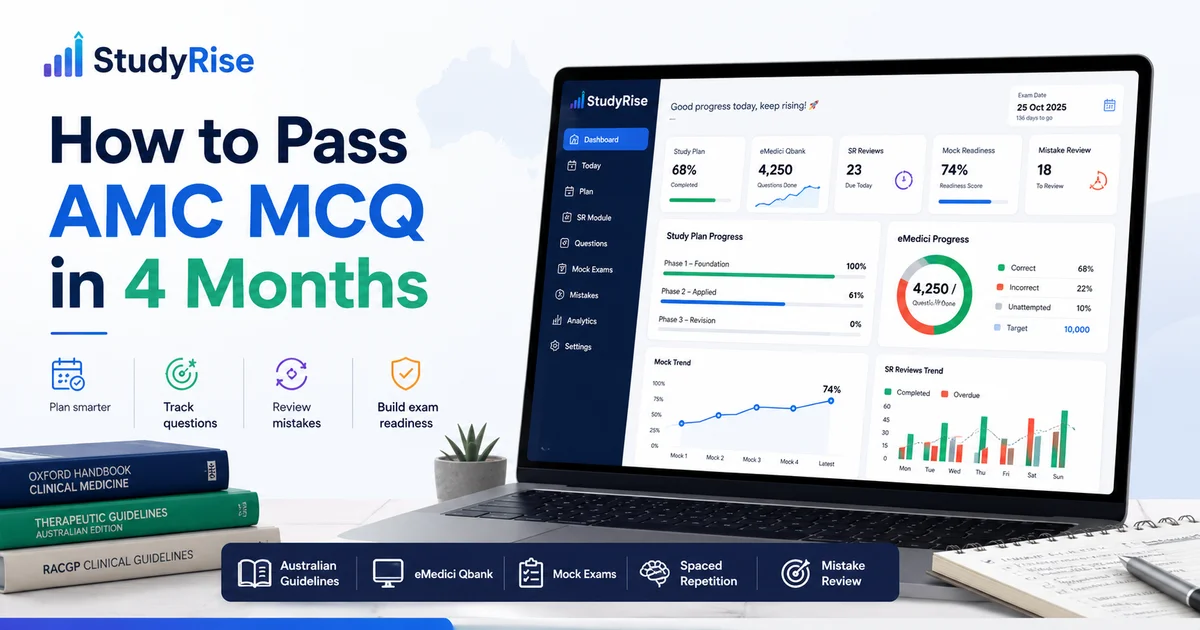
It also shows how you can use StudyRise to turn your AMC preparation into a daily system instead of a messy collection of classes, PDFs, question banks, and last-minute panic.
Important disclaimer
This article is for general educational and exam-preparation information only. It is not medical advice, legal advice, immigration advice, or official guidance from the Australian Medical Council. StudyRise does not guarantee exam results, eligibility, registration outcomes, or passing the AMC MCQ within any specific timeframe. Exam requirements, resources, fees, guidelines, and policies can change, so candidates should always verify important information directly from the Australian Medical Council and other official sources. References to third-party resources such as eMedici, First Aid AMC, Emergency Focus, Therapeutic Guidelines, RACGP, healthdirect, and RCH are for educational awareness only and do not imply endorsement, sponsorship, or affiliation unless clearly stated.
In this guide
- Can you really pass the AMC MCQ in 4 months?
- First, understand what the AMC MCQ is testing
- The best AMC MCQ resources to use
- The 4-month AMC MCQ study plan
- A practical weekly AMC MCQ schedule
- How to use StudyRise during your AMC MCQ preparation
- Common AMC MCQ mistakes to avoid
- What should your daily AMC MCQ study session look like?
- Final advice: treat AMC MCQ preparation like clinical training
First, understand what the AMC MCQ is testing
The AMC CAT MCQ examination is a computer-administered exam with 150 multiple-choice questions in one 3.5-hour session. The questions usually test applied clinical knowledge rather than textbook recall alone.
You need to be comfortable with questions such as:
- What is the most likely diagnosis?
- What is the next best investigation?
- What is the safest initial management?
- What is the red flag you must not miss?
- What is the Australian guideline-based treatment?
- What should you do in an emergency, ethical, or public health scenario?
So your preparation needs four layers:
- Core concepts — understanding medicine, surgery, women's health, paediatrics, psychiatry, emergency, ethics, and public health.
- Question practice — doing MCQs daily and learning the AMC style.
- Guideline correction — comparing your answers with Australian practice, not just what you learned in your home country.
- Revision system — revisiting weak topics before you forget them.
This is where many candidates go wrong. They study once, feel familiar with the topic, and move on. But familiarity is not exam readiness. You need retrieval, repetition, and feedback.
The best AMC MCQ resources to use
There is no single perfect resource. The safest approach is to combine structured learning, question banks, and Australian guideline checking.
1. eMedici and the official AMC MCQ Preparation App
The official AMC MCQ Preparation App is produced in partnership with eMedici and gives authorised AMC MCQ candidates access to official AMC-style questions. You should use it to understand the exam's question style and the type of reasoning expected.
You can also use eMedici more broadly for Australian clinical MCQs, explanations, and clinical reasoning practice. The key is not just to "finish the qbank." You should log:
- How many questions you attempted
- Your accuracy
- Which subjects are weak
- Which mistakes repeat
- Whether you are improving over time
A question bank only becomes powerful when you study the mistakes properly.
2. First Aid AMC or Emergency Focus for structure
If you feel lost or need a guided course, structured programs like First Aid AMC or Emergency Focus AMC MCQ can help you follow a timetable, attend classes, and cover the major AMC subjects in a planned way.
Courses can be especially useful if:
- You have been away from exam preparation for a long time
- You need accountability
- You do not know which topics are high-yield
- You want lectures, notes, recordings, and question-solving sessions
But remember: a course does not pass the exam for you. The course gives you the map. You still need to walk the road by doing questions, reviewing mistakes, and testing yourself.
3. Therapeutic Guidelines and Australian clinical websites
The AMC MCQ often rewards Australian-style safe practice. For management questions, antibiotics, preventive care, screening, and general practice decisions, you should regularly check Australian resources.
Useful resources include:
- Therapeutic Guidelines for treatment and prescribing guidance
- RACGP clinical guidelines for primary care, prevention, diabetes, osteoarthritis, choosing wisely, and general practice topics
- healthdirect for patient-facing Australian health information and common presentations
- RCH Clinical Practice Guidelines for paediatric emergency and hospital-based topics
You do not need to read every guideline from start to finish. Use guidelines strategically. When you get a question wrong, ask:
Was this a knowledge gap, or was I using non-Australian management?
That difference matters.
The 4-month AMC MCQ study plan
A 4-month timeline is realistic for some candidates, but it depends on your clinical baseline, English reading speed, available study hours, question-bank performance, and mock exam trend. You need phases.
Month 1: Build the foundation and start questions early
In the first month, your aim is to cover the major subjects once while starting MCQs from day one.
Do not make the mistake of "I will finish reading first, then start questions." AMC MCQ preparation should be question-led from the beginning.
Focus on:
- Medicine
- Surgery
- Paediatrics
- Obstetrics and gynaecology
- Psychiatry
- Emergency medicine
- Ethics and public health
- Indigenous health and culturally safe practice
A good daily structure:
- 2–3 hours: class/video/notes/topic study
- 1–2 hours: MCQs from the same topic
- 30–45 minutes: mistake review
- 20–30 minutes: spaced repetition of old topics
If you are using a course like First Aid AMC or Emergency Focus, follow the class sequence. If you are studying independently, create a subject-wise plan and divide each subject into smaller lessons.
In StudyRise, this is where you can create your AMC MCQ plan by exam date, daily hours, subjects, and study pace. Instead of guessing what to do each day, you can break large subjects into daily tasks and track whether you are actually moving forward.
Month 2: Increase question volume and start serious revision
By the second month, you should still be studying new topics, but your question volume should increase.
Your target should be:
- Daily MCQ practice
- Subject-wise question sessions
- Mistake logging
- First round of spaced repetition
- Weekly review of weak subjects
This is the month where your weaknesses become visible. That is a good thing. Low scores in Month 2 do not mean you are failing. They show you where your real curriculum is.
When you get a question wrong, classify the mistake:
- Diagnosis gap
- Investigation error
- Management error
- Red flag missed
- Guideline confusion
- Misread question
- Time pressure
- Ethics/legal issue
This is exactly the type of pattern you should track. In StudyRise, you can log question sessions, record mistakes, follow your accuracy trend, and see which subjects are repeatedly causing problems. This helps you avoid the common trap of simply doing more questions without learning from them.
Month 3: Consolidation, mocks, and weak-area repair
Month 3 is where you move from "I studied the topics" to "I can answer exam-style questions under pressure."
Your plan should include:
- Mixed question blocks
- Timed sessions
- Full or partial mock exams
- Subject-wise weak area review
- Guideline correction
- Spaced repetition of completed subjects
Do not only review the subjects you enjoy. Most candidates naturally revise their strong areas because it feels satisfying. But the exam score improves when you repair weak areas.
After each mock or timed block, ask:
- Which subjects pulled my score down?
- Was I weak in diagnosis, investigation, or management?
- Did I miss emergency red flags?
- Did I lose marks because of Australian guideline differences?
- Did I run out of time?
- Did I repeat the same mistake from last week?
StudyRise can help here by connecting your study plan, question logging, mock results, mistakes, and analytics. The goal is not just to see a graph. The goal is to decide what tomorrow's study should be.
For example, if your mock shows weak performance in cardiology and your mistakes show repeated management errors, your next task should not be "read medicine randomly." It should be a focused cardiology management review followed by targeted MCQs and re-testing.
Month 4: Exam simulation and final revision
The final month should be less about learning everything from scratch and more about performance.
Your priorities should be:
- Full timed mocks
- Reviewing incorrect questions
- High-yield guideline topics
- Emergency presentations
- Ethics and public health
- Indigenous health and culturally safe practice
- Final spaced repetition
- Sleep and exam-day pacing
At this stage, avoid collecting new resources. Resource-hopping is one of the biggest reasons candidates feel busy but do not improve. Choose your core resources and finish the loop.
A good final-month weekly rhythm:
- 1–2 mock exams or large timed blocks
- 2–3 weak-area repair days
- Daily mistake review
- Daily spaced repetition
- Short guideline checks
- One lighter day to recover and prevent burnout
Your final revision should be active. Do not just reread notes. Use questions, self-testing, short summaries, and mistake re-testing.
A practical weekly AMC MCQ schedule
Here is a realistic weekly structure for a candidate studying 4–6 hours per day.
5-day study week
Day 1: New topic + subject MCQs + mistake log
Day 2: New topic + subject MCQs + SR review
Day 3: Mixed MCQs + guideline correction
Day 4: Weak subject repair + targeted MCQs
Day 5: Timed block or mini-mock + full review
Day 6: Light revision or catch-up
Day 7: Rest or short spaced repetition only
6-day study week
4 days: Topic coverage + MCQs
1 day: Mixed timed questions
1 day: Weak-area review and mock analysis
1 day: Rest or light SR
The exact plan depends on your baseline. If you are working full-time, you may need 5–6 months. If you are already strong clinically and can study full-time, 4 months may be enough.
The important thing is to track reality, not intention. A beautiful plan means nothing if you do not know whether you followed it.
How to use StudyRise during your AMC MCQ preparation
AMC candidates often struggle because their preparation is scattered across lecture portals, PDFs, Telegram groups, eMedici, recalls, notes, and random to-do lists. StudyRise is designed to bring the daily system into one place.
You can use StudyRise to:
1. Build your AMC MCQ study plan
Set your exam date, study start date, daily hours, and subjects. StudyRise helps turn the full AMC syllabus into daily tasks so you know what to study today, not just "what exam you have someday."
2. Track daily study and question progress
Log how many questions you attempted, your accuracy, and which question bank you used. This helps you see whether you are actually building enough question volume before the exam.
3. Use spaced repetition properly
StudyRise tracks SR reviews for completed subjects, so you do not forget cardiology while studying psychiatry, or forget paediatrics while doing surgery. The point is not to study once. The point is to come back before the memory fades.
4. Review mistakes instead of just collecting them
Your incorrect questions are not failures. They are instructions. StudyRise's mistake-tracking and exam-mode workflow can help you turn mistakes into a review queue, so you can revisit weak areas, re-test yourself, and confirm whether the issue is resolved.
5. Track mock exam readiness
Mocks are not just scores. They are diagnostic tools. StudyRise helps you track mock trends, subject performance, and readiness so you can see whether your preparation is moving in the right direction.
6. Avoid burnout and random studying
A good AMC plan should be demanding but realistic. StudyRise helps you see your daily workload, overdue tasks, question deficit, SR due list, and weak areas. This makes it easier to adjust the plan before you fall too far behind.
Common AMC MCQ mistakes to avoid
Mistake 1: Reading too much before starting MCQs
AMC preparation should be question-led. Start questions early, even if your score is low.
Mistake 2: Not reviewing incorrect answers deeply
Do not just read the explanation and move on. Ask why you got it wrong and what rule you will use next time.
Mistake 3: Ignoring Australian guidelines
Some answers may differ from what you practised in your home country. Use Australian resources to correct management decisions.
Mistake 4: Doing only subject-wise questions
Subject-wise questions are useful early. But by Month 3, you need mixed timed blocks because the real exam will not tell you which subject the question belongs to.
Mistake 5: Avoiding mocks until the end
Mocks should start early enough to guide your preparation. If your first mock is one week before the exam, you have very little time to fix what it reveals.
Mistake 6: Changing resources every week
Pick a small number of good resources and use them properly. More resources do not automatically mean better preparation.
What should your daily AMC MCQ study session look like?
A strong daily session can look like this:
- Start with review: 20–30 minutes of spaced repetition or yesterday's mistakes.
- Study one focused topic: Watch a class, read notes, or revise a guideline.
- Do related MCQs: Apply the topic immediately.
- Log mistakes: Write what went wrong and what the correct rule is.
- Do a short mixed block: Keep your brain used to switching topics.
- Update your tracker: Mark tasks, questions, SR, and mistakes.
The final step matters. If you do not track your work, you cannot improve your system.
Final advice: treat AMC MCQ preparation like clinical training
The AMC MCQ is not just a memory exam. It is a safe-practice exam. The best candidates think like safe junior doctors in the Australian system.
That means your preparation should train you to:
- Recognise red flags
- Choose safe initial management
- Know when to refer
- Use Australian guideline-based treatment
- Understand common GP and ED presentations
- Manage uncertainty under time pressure
- Learn from mistakes quickly
A 4-month AMC MCQ plan can support your preparation if it is structured, active, and feedback-driven. Use a course if you need structure. Use eMedici and the AMC preparation app for question style. Use Therapeutic Guidelines, RACGP, healthdirect, and RCH guidelines to align with Australian practice. Most importantly, build a daily system that tells you what to study, what to review, what you are weak in, and whether you are actually getting closer to passing.
Use this guide as a planning framework, not as a guarantee of results.
That is exactly why StudyRise exists: to help AMC MCQ candidates move from scattered preparation to a clear plan, daily accountability, spaced repetition, mock tracking, mistake review, and exam-readiness insight.
Before you rely on this guide
This article is for general educational and exam-preparation information only. It is not medical advice, legal advice, immigration advice, or official guidance from the Australian Medical Council. StudyRise does not guarantee exam results, eligibility, registration outcomes, or passing the AMC MCQ within any specific timeframe. Always verify important information directly from the Australian Medical Council and other official sources.
Study hard — but study with feedback. That is what can improve your chance over four months. Start your AMC MCQ study plan on StudyRise today.
Try StudyRise free